

Expert Industry Insights
Get current insights from our experts on methane monitoring technology, news, initiatives and regulations.
Emission Detection from Heights: Improvements to Qube’s Plume Modeling
Here we show how improvements to our source modeling resulted in better detection of emissions at heights - like storage tanks. These results are verified by blind, third-party testing at METEC in 2025 where Qube’s continuous monitoring detected all releases from heights during the testing period.
Qube’s Probabilistic Duration Model for Methane Emissions
What’s New?
Improved emission event bounding that accounts for source coverage
Source coverage is calculated based on whether devices are downwind of a particular source at a given time
We use short term probability to determine if correlation between source coverage and methane readings is coincidence or correlated
Given high enough probability, we can fill in short gaps and extend emissions
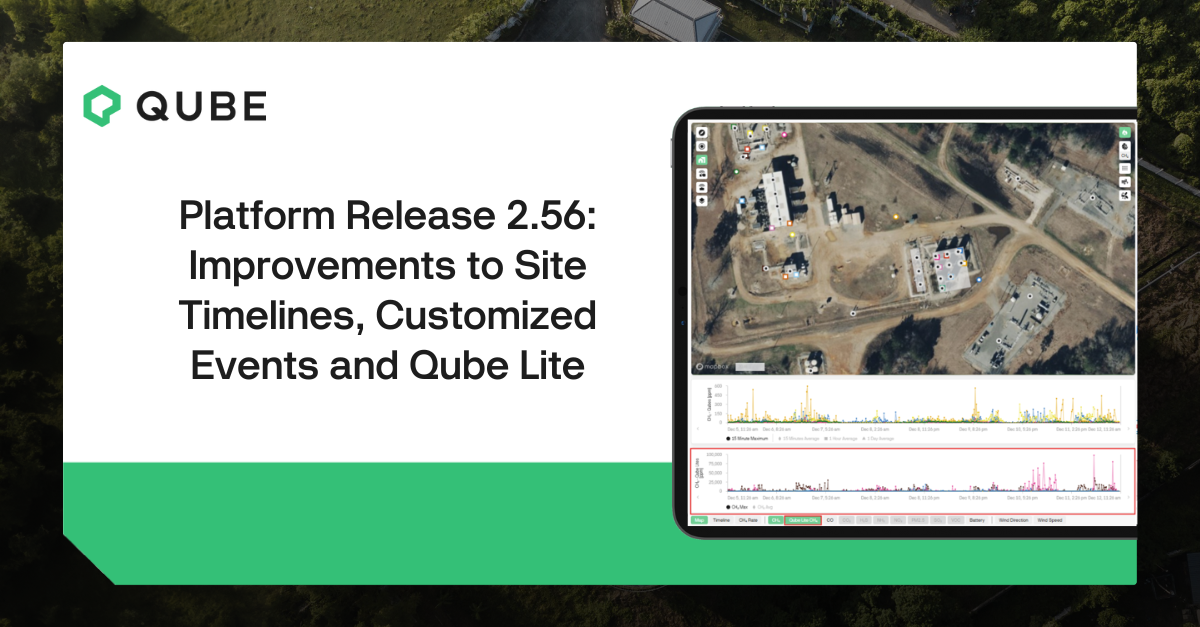
Qube Platform Release 2.56: Improvements to Site Timelines, Customized Events and Qube Lite
Release 2.56 brings user-created events and other improvements to the site timeline as well as better emissions visibility by Qube Lite.

Qube’s Emissions Detection, Localization and Quantification Results from METEC ADED 2025
Independent testing at Colorado State University’s METEC Advancing Development of Emissions Detection (ADED) program shows that Qube’s continuous monitoring system reliably detects the leaks that drive most methane emissions at oil and gas sites. Compared with our 2024 campaign, Qube delivered stronger performance under more demanding test conditions.
In this article we walk through the results in four areas: localization, emission rate prediction, detection capability, and quantification. We also link to the final METEC report so you can review the full third-party results.

Qube Platform Release 2.55: Default Filters and Alarm Notifications
Release 2.55 is here. If you manage emission monitoring for a subset of assets, this update is for you. Set your Default Filter to focus the Overview and Emission Analytics on only your sites or regions and optionally limit alarm notifications to the same filter to cut noise.

Understanding Probability of Detection and Time-to-Detection: The Continuous Monitoring Advantage
For continuous monitoring, Probability of Detection (PoD) can be framed as a function of time. Detection confidence grows with each measurement window. Here we explain how controlled-release testing and time segmentation translate PoD into Time-to-Detection (TtD) and contrast that with single-pass survey methods. For operators, this provides a practical way to set expectations for how quickly a continuous system will find different-sized events and why that matters for response.

Time-Bounding Large Release Events with Continuous Monitoring
Most LDAR methods capture only a snapshot, so they miss when an event starts, when it ends, and how long it lasts. Without that timeline, it can be challenging to quantify released volume, verify repairs, or determine whether the source is constant, intermittent, or tied to specific operations. Qube’s continuous monitoring provides 24/7 data that time-bounds emission events, enabling accurate volume estimates and confident repair verification.

Qube Platform Release 2.54: Enhancements to Qube Lite Functionality and Visualization
Release 2.54 is live. Operators running mixed deployments of Qube Axon and Qube Lite can now identify device type at a glance, distinguish severity faster, and tailor Qube Lite alarms to each monitored equipment. It’s improved operational awareness and faster responses.

Fewer Site Visits, Faster Repairs: Results from Qube’s EPA-Approved Periodic Screening
In March 2025, EPA approved Qube continuous monitoring as an alternative technology for periodic inspections under NSPS OOOOb/c ( and applicable to OOOOa). Here we detail how it works. Pick a 7-day window and a 90% PoD threshold. The 7-day block average either passes or fails, and crews conduct site inspections only upon fails. The results are less routine visits, faster repairs, and reduced costs across sites.

Qube Platform Release 2.53: Zoom In on Emission Rates and Customize Alarms at the Device Level
Release 2.53 is live. You can now zoom into low-level concentration changes and set measurement-based alarms per device for tighter, location-specific monitoring.

How Qube’s Continuous Monitoring Found Leaking Level Controllers After Well Restart
A Colorado well pad restarted after a non-routine shut-in. Within hours, Qube’s continuous monitoring flagged methane levels consistent with a large release event (estimated at >100 kg/h, about 125 mscf/d). The operator’s LDAR team located badly leaking level controllers and multiple thief hatches and completed repairs in under 24 hours. The operator then initiated a fleet-wide replacement of aging controllers to prevent recurrence.

Qube Lite Field Tested for Real-World Operations at Tourmaline’s West Wolf Lake Gas Plant
Our Product and Ops Teams installed Qube Lite at Tourmaline Oil Corp's West Wolf Lake Gas Plant as part of the NGIF Accelerator's Emission Testing Centre Program.
Qube Lite is our new intrinsically safe, lower-cost continuous monitoring sensor, designed for near-source deployment. Perfect to zero-in on individual equipment (e.g., tanks, separators, wellheads, etc.).
Initial results were positive with easy installation and seamless activation, even in less than ideal weather.

Qube Platform Release 2.51: Filter Quicker. Track Smarter. Arrive Prepared.
Release 2.51 is live! It brings faster site filtering, emissions source performance tracking, and capability to provide the info you need to know before arriving at site.

Qube Technologies Wins Industry Innovation Award from Western Energy Alliance
Qube Technologies is proud to receive the Industry Innovation Award from Western Energy Alliance.
The award recognizes Qube’s leadership in developing real-time methane monitoring technology for oil and gas operators. The Western Energy Alliance celebrates companies and individuals making a lasting impact on the industry across the western United States.

Maas Energy Works Expands Partnership with Qube Technologies to Monitor Biogas Operations Across Multiple States
Qube Technologies, a leader in continuous emissions monitoring, today announced an expanded partnership with Maas Energy Works (MEW) to deploy Qube’s monitoring devices across more than 20 lagoon-style digesters in Texas, Idaho, and California. Following the success of an initial pilot, MEW will now implement Qube’s real-time monitoring solution across its broader network to enhance operational visibility, reduce emissions, and optimize biogas production at scale.

Qube’s Continuous Monitoring Uncovers Blocked Vent Line: Emissions Drop 80% at Colorado Wellsite
At a Colorado wellsite, Qube’s continuous monitoring system alerted operators to a sustained emission event. Qube’s data localized the emissions to the tank area and prompted a field investigation to verify the source of the anomaly. With this information, the team was able to identify the emission source and interrogate the root cause, a blocked vent line leading to the combustor.

Qube Platform Release 2.50: Smarter Alarms & Improved Emission Analytics
Platform Release 2.50 is now live! This update delivers more user alarm control and visualized insights, leading to better operational performance.

Rapid Leak Detection in the Piceance Basin: How Qube Helped Catch A Separator Leak
In Colorado’s Piceance Basin, a leading operator continues to set the bar for emissions control and operational safety. By integrating Qube Technologies’ continuous methane monitoring system, the operator aimed to strengthen its LDAR program and protect nearby homes located within 1,000 feet of its well pad.
This case study details how real-time alarms and accurate emissions source localization led to rapid action at the wellsite. Notably, catching a high-volume leak at the separator from going unnoticed over the weekend.

Certified Secure: Qube’s Continuous Methane Monitoring Platform Meets SOC 2 Type II Standards
Qube has officially passed its SOC 2 Type II audit. This achievement confirms that our controls, processes, and infrastructure consistently meet high standards for data security, availability, and confidentiality.

Smarter Sampling, Sharper Signals: How Qube Cuts Bandwidth and Power Use in Methane Monitoring
Continuous monitoring provides a clear advantage: it constantly captures emissions data 24 hours a day. But this volume of data comes at a significant cost of bandwidth and power.
How can operators maintain reliable monitoring without straining their networks or batteries? Qube solves this by combining efficient power use with intelligent sampling techniques.
Here we review the advances in sampling, data compression, and payload frequency that make this possible.