
Expert Insights
Get current insights from our experts on methane monitoring technology, news, initiatives and regulations.
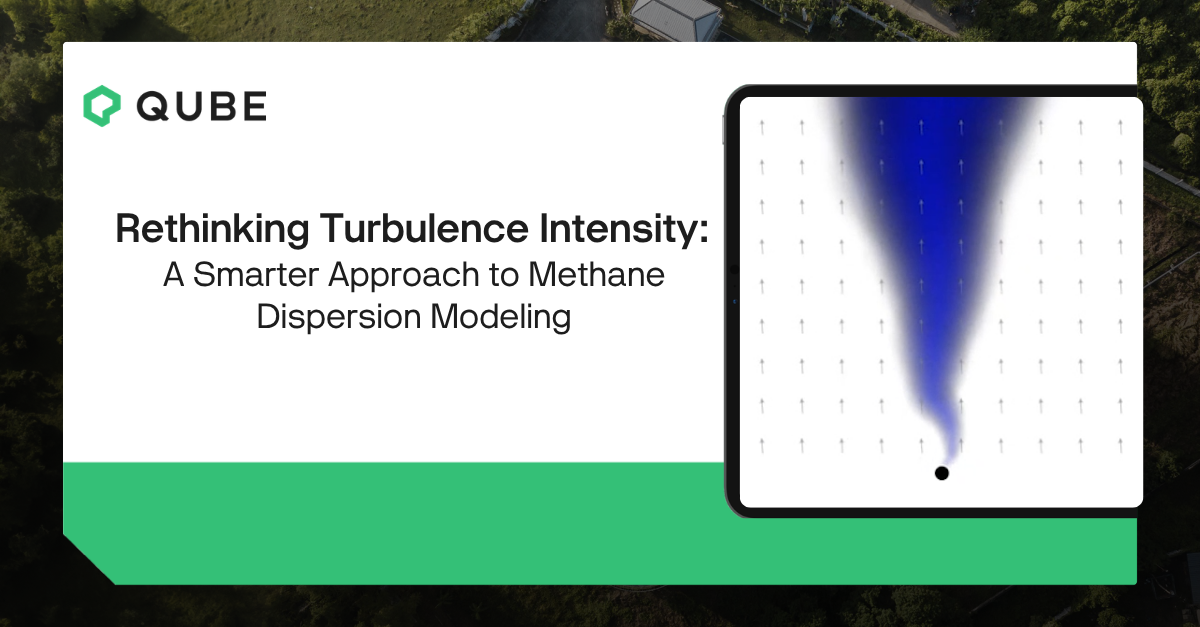
Rethinking Turbulence Intensity: A Smarter Approach to Methane Dispersion Modeling
Emission models are just as important as the devices used to detect methane.
Here, we show how we have improved our emissions model to better account for turbulence, the rapid fluctuations in wind direction and speed that drive dispersion.

Qube’s Emissions Detection, Localization and Quantification Results from METEC ADED 2025
Independent testing at Colorado State University’s METEC Advancing Development of Emissions Detection (ADED) program shows that Qube’s continuous monitoring system reliably detects the leaks that drive most methane emissions at oil and gas sites. Compared with our 2024 campaign, Qube delivered stronger performance under more demanding test conditions.
In this article we walk through the results in four areas: localization, emission rate prediction, detection capability, and quantification. We also link to the final METEC report so you can review the full third-party results.

Understanding Probability of Detection and Time-to-Detection: The Continuous Monitoring Advantage
For continuous monitoring, Probability of Detection (PoD) can be framed as a function of time. Detection confidence grows with each measurement window. Here we explain how controlled-release testing and time segmentation translate PoD into Time-to-Detection (TtD) and contrast that with single-pass survey methods. For operators, this provides a practical way to set expectations for how quickly a continuous system will find different-sized events and why that matters for response.

Smarter Sampling, Sharper Signals: How Qube Cuts Bandwidth and Power Use in Methane Monitoring
Continuous monitoring provides a clear advantage: it constantly captures emissions data 24 hours a day. But this volume of data comes at a significant cost of bandwidth and power.
How can operators maintain reliable monitoring without straining their networks or batteries? Qube solves this by combining efficient power use with intelligent sampling techniques.
Here we review the advances in sampling, data compression, and payload frequency that make this possible.