
Rapid Leak Detection by Continuous Monitoring Results in 87% Emissions Reduction at a Lined Biogas Lagoon
Challenge
Dairy farms are increasingly adopting anaerobic digesters to capture methane-rich (CH₄) biogas from manure and reduce emissions¹. Maas Energy Works (Maas) is helping lead this effort by converting a dairy byproduct into renewable natural gas (RNG). Maas operates anaerobic digesters that capture CH₄ from manure, creating clean energy from a waste stream.
Following a small pilot, Maas expanded Qube’s continuous monitoring to 24 additional digesters across California, Texas, and Idaho. This case study highlights monitoring large-scale lagoon sites in a complex environment due to cross-detected emissions from nearby open manure lagoons. Specifically, prevailing northwesterly winds carried methane from an adjacent open lagoon to the digester area, complicating emissions detection efforts for the covered lagoon (Fig. 1). To add to this, conventional walk-by inspections had been unable to identify any leaks.
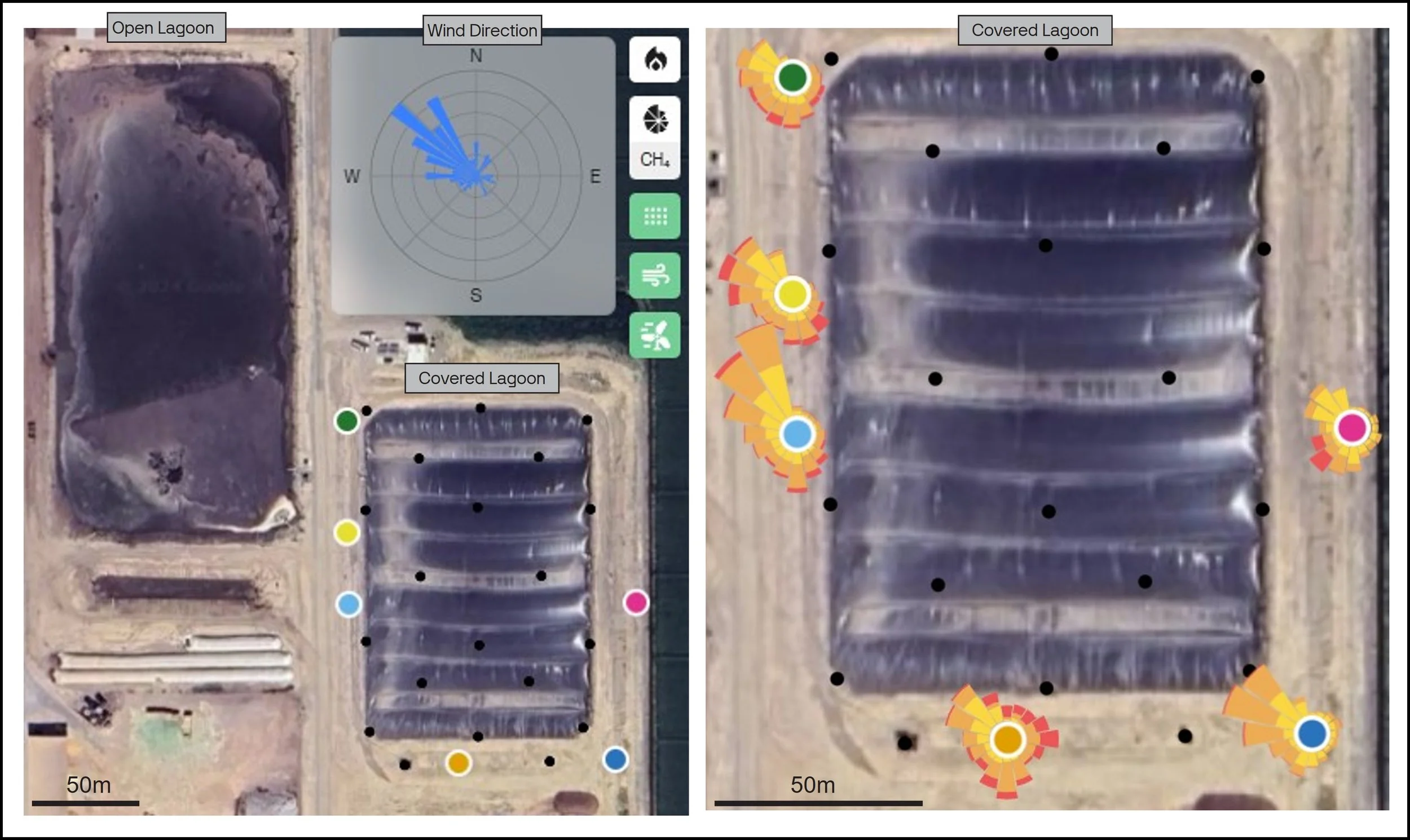
Figure 1. Layout of Qube’s continuous monitoring devices (colored circles) at Maas’s dairy lagoon with an open lagoon at the northwest and northwesterly winds (left panel). In the right panel, concentration roses around each device point to methane coming from the open lagoon, indicating prevalent emissions outside the monitored covered lagoon.
Solution
During the deployment planning process, Qube uses historical wind data and knowledge of any offsite sources to generate optimal device placement locations. Once deployed, Qube’s physics-based model uses real-time wind data from anemometers on each device to analyze the direction of any elevated methane readings. This allows the model to filter out any CH₄ coming from offsite sources, ensuring that detections and estimated emission volumes are from actual onsite sources.
Soon after deploying devices at this lined lagoon, Qube’s system detected persistent emissions coming from an area of the cover that operators had walked by many times without detecting (Fig. 2). After receiving the emission alert from Qube, operators re-examined the area and discovered a broken weld around the sludge port.
Results
This weld was repaired, leading to an 87% decrease in methane emissions. The decrease in measured emissions corresponded directly to increased gas capture, as monthly gas production increased by over 1,000 MMBtu from August to September. This demonstrated a clear example of the win-win nature of continuous monitoring – environmental excellence going hand in hand with business objectives.
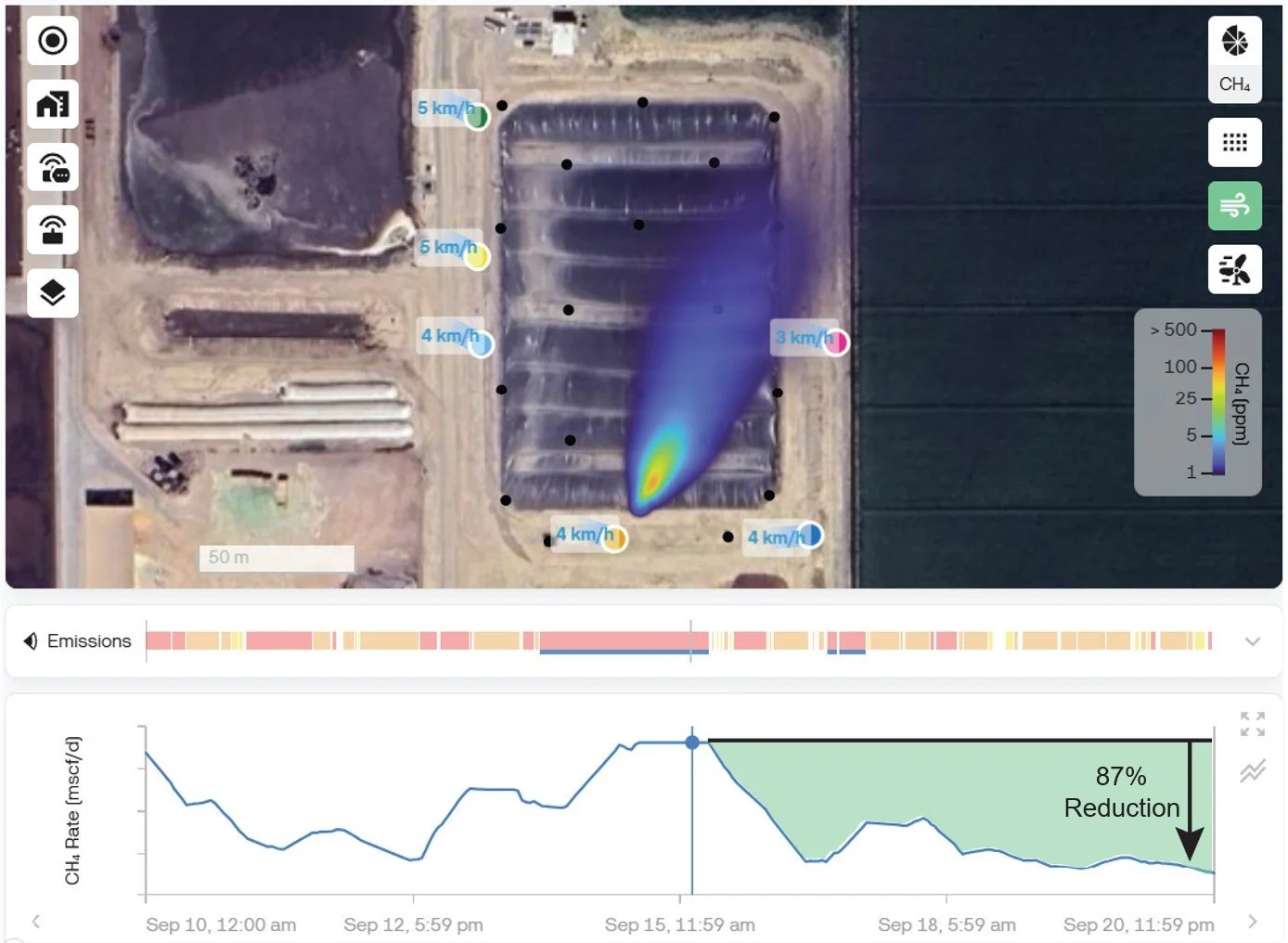
Figure 2. Qube’s continuous methane monitoring devices detected persistent methane emissions near the south end of the lagoon cover, visualized via the platform’s simulated plume display. Post-repair monitoring verified a sustained 87% reduction in CH₄ emissions. These results demonstrate Qube’s capability to both detect emission events and confirm the effectiveness of mitigation efforts in real time.
What It Means for RNG Operators
Qube’s continuous monitoring solution for RNG lets operators detect and repair leaks as they happen, minimizing emissions and maximizing product retention.
Following a successful pilot on a single site, Maas expanded Qube devices to 24 additional digesters across California, Texas, and Idaho. These deployments have already shown early success as evidenced by the case studies presented here.
You can find more details about this multi-state expansion with Maas in our press release here.
Learn How Qube’s Continuous Monitoring Can Help Your RNG Operations
Interested in real-time leak detection and emissions monitoring for your RNG operations? Get firsthand experience with one of our experts and see how continuous monitoring can protect your assets.
Book a demo with our team today.
Reference
1. Rogriguez, M.V., Rojas Robles, N., Carranza, V., Thiruvenkatachari, R., Reyes, M., Preble, C.V., Pexton, J., Meyer, D., Anderson, R.G., Venkatram, A., Hopkins, F.M. 2025. Anaerobic Digester Installation Significantly Reduces Liquid Manure Management CH4 Emissions at a California Dairy Farm. GCB Bioenergy. 17(7):e70047. https://doi.org/10.1111/gcbb.70047
Explore our other resources and case studies or reach out directly.