
Continuous Monitoring at an Unlined RNG Pond with Clay Bottom Leads to 67% Emissions Reduction
Challenge
Dairy farms are increasingly adopting anaerobic digesters to capture methane-rich (CH₄) biogas from manure and reduce emissions¹. Maas Energy Works (Maas) is helping lead this effort by converting a dairy byproduct into renewable natural gas (RNG). Maas operates anaerobic digesters that capture CH₄ from manure, creating clean energy from a waste stream.
In August 2024, Maas piloted Qube Technologies’ continuous monitoring system at one site. The results were immediate, enabling on-site operators to identify leaks faster, action quicker repairs, and enhance gas collection volume. Following the pilot, Maas expanded Qube’s system to 24 additional digesters across California, Texas, and Idaho
In this scenario, Maas deployed Qube’s continuous monitoring solution was deployed to detect emissions at an unlined pond with a clay bottom. An unlined pond means that the outer edge of the top cover must form a tight seal against dirt rather than an HDPE liner, as is the case with most covered lagoons.
Once Qube’s fenceline devices were installed in mid-December, they were consistently detecting emissions at these cover seams around the outer edge of the lagoon.
Solution
As these leaks were being diffused through soil rather than releasing from a concentrated point source, the CH₄ concentration was too low to detect with a typical walking survey. The Qube system highlighted the problem areas for the operator to further investigate. The inspection uncovered several areas where the underlying soil was soft and required compaction.
Results
Once the soil in these areas was recompacted, measured emission levels decreased by 67% (Fig. 1).
Reflecting on the first month of the pilot, one of the Maas operators noted:
“Our whole team has been very impressed with the Qube deployment. Many of the leaks the Qube devices have detected were almost impossible to find and required [our operator] to get creative when investigating them.”
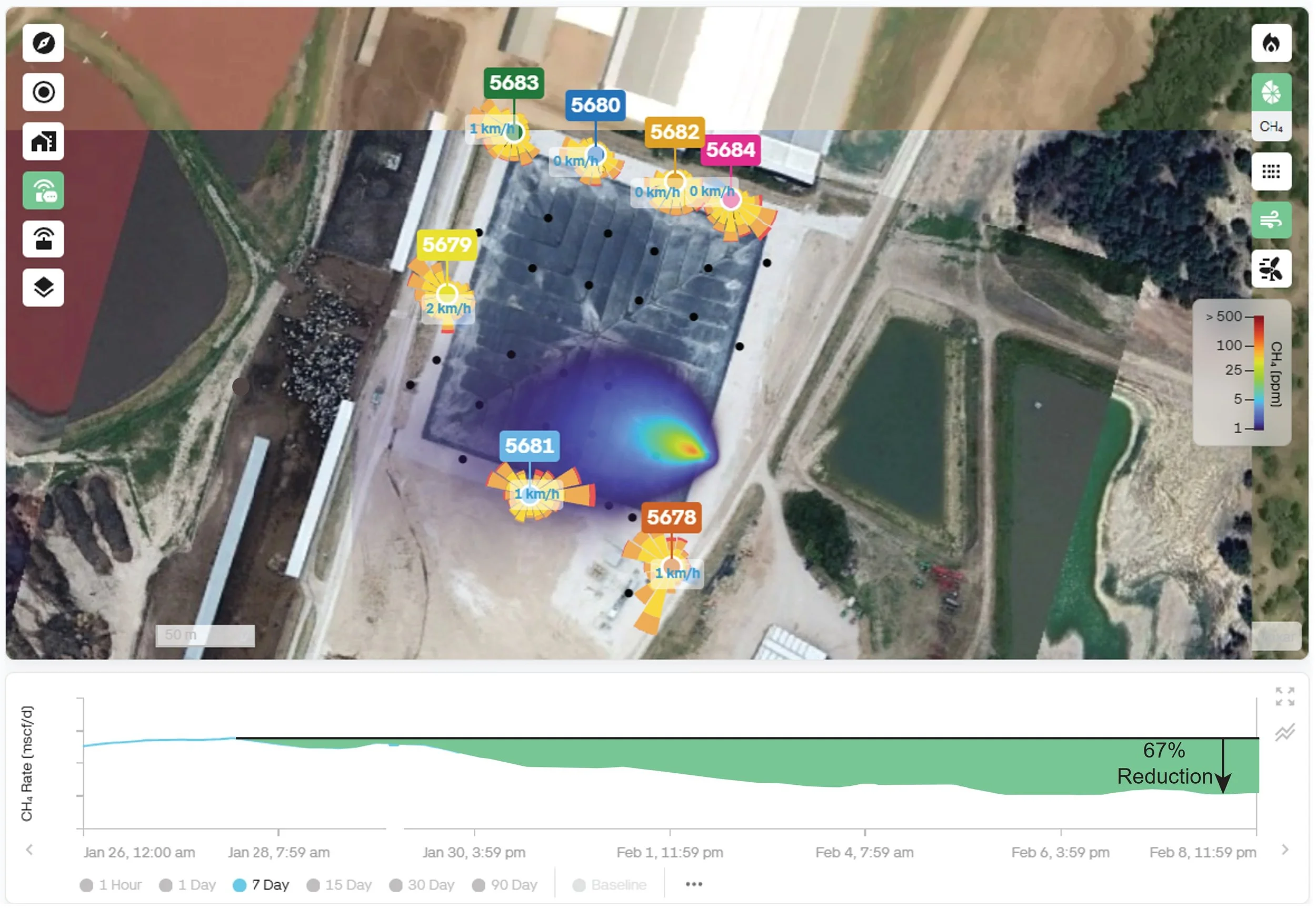
Figure 1. Qube’s continuous methane monitoring devices identified small, otherwise undetectable perimeter leaks from uncompacted soil at an unlined lagoon. Using Qube’s real-time data, operators localized and repaired problem areas, reducing methane emissions by 67%, while minimizing inspection time and labor.
What It Means for RNG Operators
Qube’s continuous monitoring solution for RNG lets operators detect and repair leaks as they happen, minimizing emissions and maximizing product retention.
Following a successful pilot on a single site, Maas expanded Qube devices to 24 additional digesters across California, Texas, and Idaho. These deployments have already shown early success as evidenced by the case studies presented here.
You can find more details about this multi-state expansion with Maas in our press release here.
Learn How Qube’s Continuous Monitoring Can Help Your RNG Operations
Interested in real-time leak detection and emissions monitoring for your RNG operations? Get firsthand experience with one of our experts and see how continuous monitoring can protect your assets.
Book a demo with our team today.
Reference
1. Rogriguez, M.V., Rojas Robles, N., Carranza, V., Thiruvenkatachari, R., Reyes, M., Preble, C.V., Pexton, J., Meyer, D., Anderson, R.G., Venkatram, A., Hopkins, F.M. 2025. Anaerobic Digester Installation Significantly Reduces Liquid Manure Management CH4 Emissions at a California Dairy Farm. GCB Bioenergy. 17(7):e70047. https://doi.org/10.1111/gcbb.70047
Explore our other resources and case studies or reach out directly.