
Continuous Monitoring Detected Multiple, Distinct Emissions Events at a Compressor Station
Over three weeks, a Colorado compressor station had two separate emission events detected by Qube Fenceline devices. Qube’s continuous monitoring accurately detected and localized both events, and confirmed repairs were successfully completed while the team was still on site.
“We continually learn about these facilities when we have the [Qube] monitors out there!” the Air Compliance Manager said. “We are starting to realize more and more that emissions that manifest themselves at the tanks are often associated with problems/issues far upstream of the tanks themselves.”
Introduction
A compressor station has many places where gas can escape. Separation vessels, compressors, pigging equipment, and tanks all sit within a few hundred feet of each other. When emissions show up, the hard part is working out which piece of equipment is responsible.
Over three weeks in spring 2026, a Colorado compressor station had two separate emission events. They came from different equipment in different parts of the site. Continuous monitoring found both of them and confirmed both repairs.
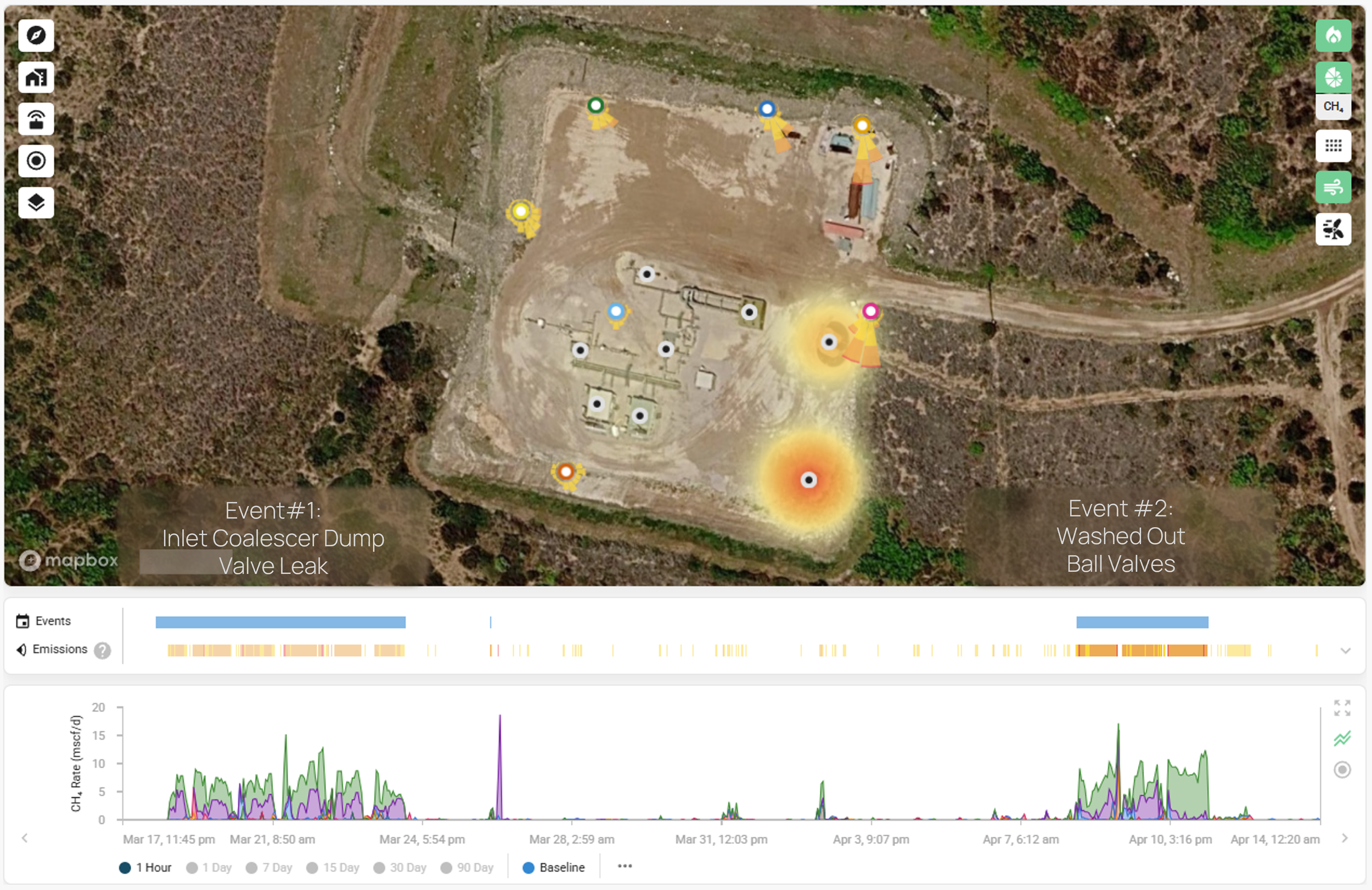
The Site Dashboard on the Qube Platform. Two separate emission events were clearly detected and localized by Qube Fenceline devices deployed around the site (colored circle icons) and analyzed by multi-source emission modeling.
Emissions Event #1: Leaking Valves on the Inlet Coalescer
In mid-March, the sensors picked up methane above normal levels. The readings were strongest near the tank area. The rate peaked above 17 mscf per day.
The tanks were not the source. The field team traced the gas to manual drain valves on the inlet coalescer. These valves release liquid from the vessel into a tank. Over time, liquid passing through wears down the sealing surface. Once that happens, gas escapes along with the liquid and travels to the tank.
On the morning of March 26, the crew blew down the coalescer and replaced the failed valves. The emissions dropped back down to baseline levels. This drop was verified by Qube’s continuous monitoring.
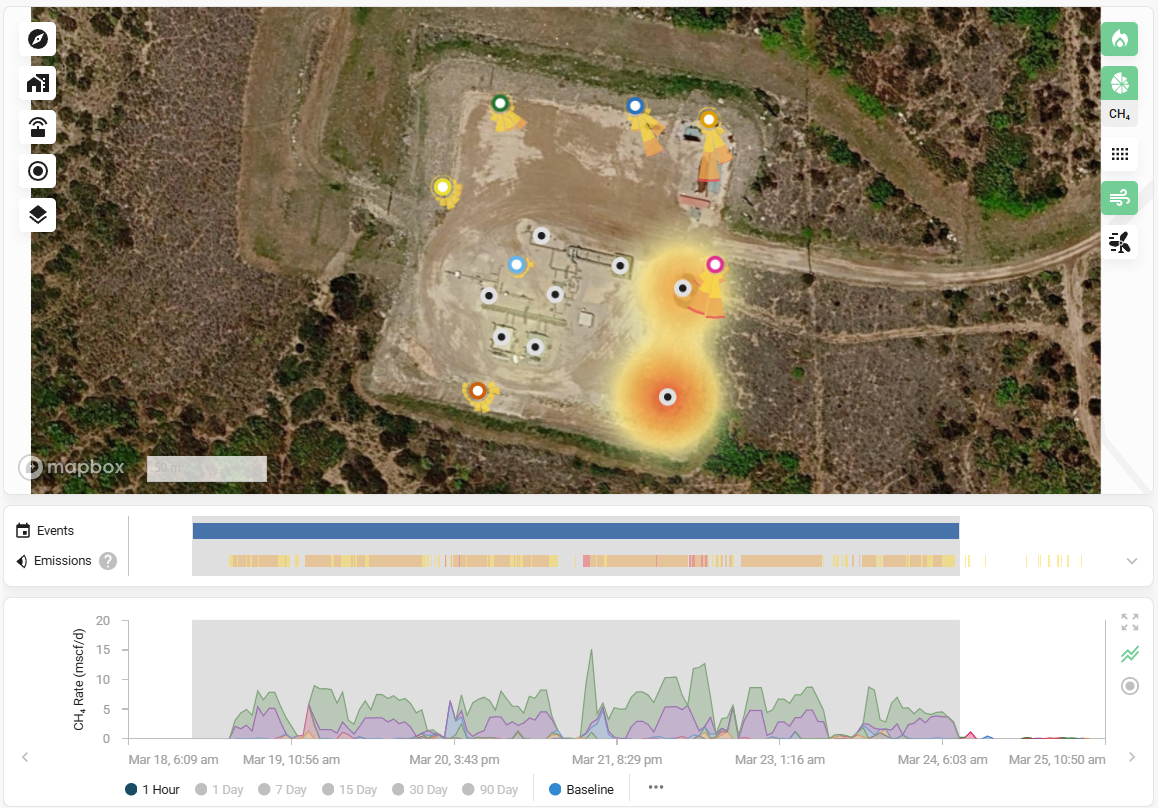
The first emissions event captured in the Qube Platform. Persistent emissions were detected and localized to the
Emissions Event#2: Tank Venting Caused by Washed Out Ball Valves
There were no emissions events for nearly two weeks. A new event was flagged by the Qube Platform. The crew had started up a compressor, and it required purging the unit. A purge releases gas, so a short rise in readings was expected. But the methane did not drop afterwards. The air compliance manager flagged the persistent emissions and noted Qube’s site dashboard pointed to the tank area once more.
The field team went back out on the morning of April 11th. They found more washed-out ball valves on the fuel gas scrubber. They isolated the dump line and confirmed gas was no longer reaching the tank. Qube Fenceline devices verified the rapid drop in emissions following isolation. The field team swapped the old ball valves with new ones and the emissions did not return. All details from the initial detection and diagnosis were captured as an event in the site timeline on the Qube Platform.
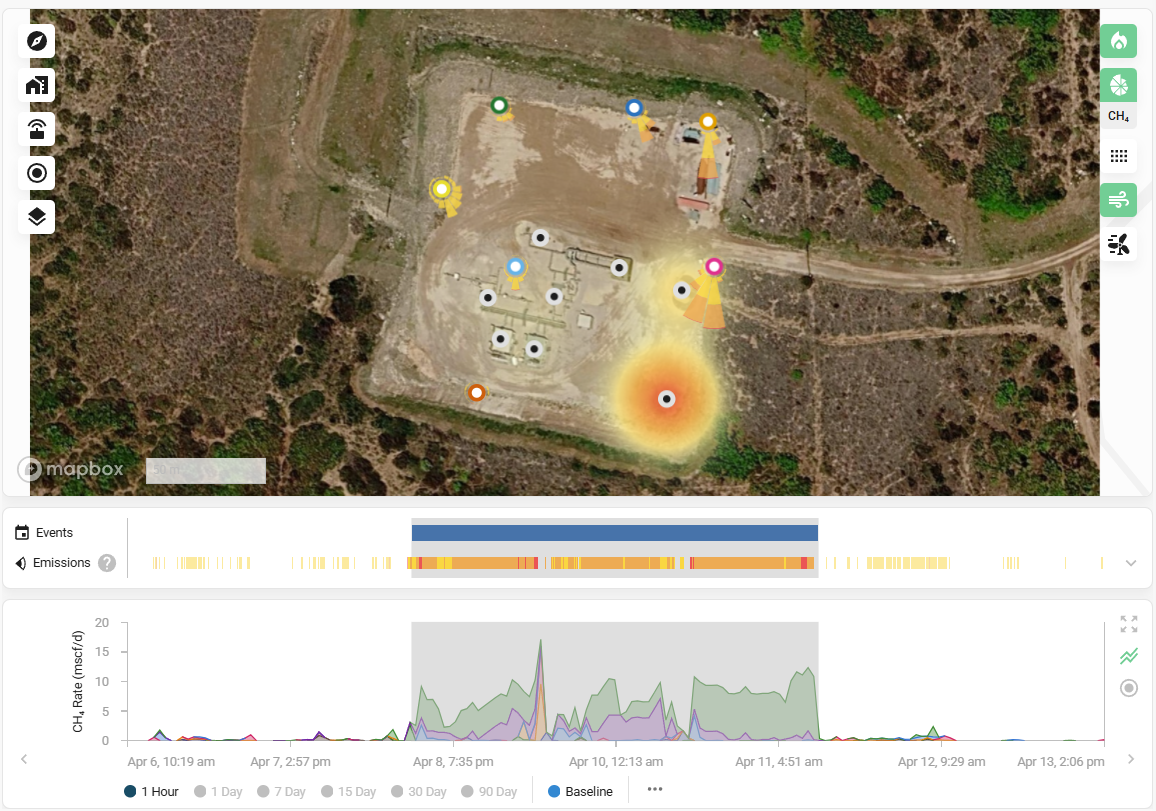
The second emissions event was localized to the tank area. Upon investigation, the field team found washed out ball valves that required replacing. Isolating the lines immediately dropped the emissions back to baseline levels.
What the Operator Learned
“We continually learn about these facilities when we have the [Qube] monitors out there!” the Air Compliance Manager said. “We are starting to realize more and more that emissions that manifest themselves at the tanks are often associated with problems/issues far upstream of the tanks themselves.”
The operator found that gas showing up at the tanks was the result of equipment issues upstream. Emissions passed through failed valves and vented at the first open point it reached. Through continuous monitoring, the operator gained a clearer picture of end-to-end operations at the compressor station.
Key Takeaways
Across both events, Qube’s continuous monitoring did four things for this team:
It detected each release quickly.
It localised the source accurately enough to send the crew to the right equipment.
It recorded each event in the dashboard with start times, end times, and field notes, so the history is available for future reference and reporting.
And it verified that each repair had worked, while the crew was still on site.
Interested in real-time leak detection and emissions monitoring? Get a demo from one of our experts and see how continuous monitoring can protect your assets.
Book a demo with our team today.
For more information, explore our other resources and case studies or reach out directly.