
How Continuous Monitoring Detected Compressor Issues During Severe Winter Storms
A severe winter storm caused repeated compressor trips across multiple tank batteries and compressor stations. Each trip resulted in a blowdown and release to atmosphere. Here's how Qube’s continuous monitoring tracked the emissions and diagnosed the process gap behind them.
Introduction
When a winter storm caused ice plugs in the compression equipment and frozen control systems and pressure sensors at an oil facility, the result was a series of repeated compressor trips and restarts. Qube's continuous monitoring system tracked the emissions through each blowdown, providing the data needed to diagnose what was happening and why.
Detection
Elevated emissions were detected at the facility during the winter storm event. The monitoring data showed a repeating pattern of spikes rather than a single sustained elevation, which indicated an event-driven source rather than a continuous leak or failure. That emissions were released in discrete intervals was useful diagnostic information.
Qube Fenceline units are built for permanent outdoor installation and continue operating through the temperature extremes, wind, and icing that come with a severe winter event. Operators limit time outdoors in those conditions, and because the devices kept measuring through the storm, the crew could keep site visits to a minimum.
Investigation
Review of monitoring data alongside operational records confirmed the source: compression equipment was repeatedly cycling on and off throughout the storm. Each time a compressor tripped and was restarted, it required a blowdown to safely release pressurised gas before the restart sequence could complete. Those blowdowns were going directly to atmosphere. The result was a predictable emissions event with each restart. In storm conditions where equipment tripped multiple times, the blowdowns accumulated through the event.
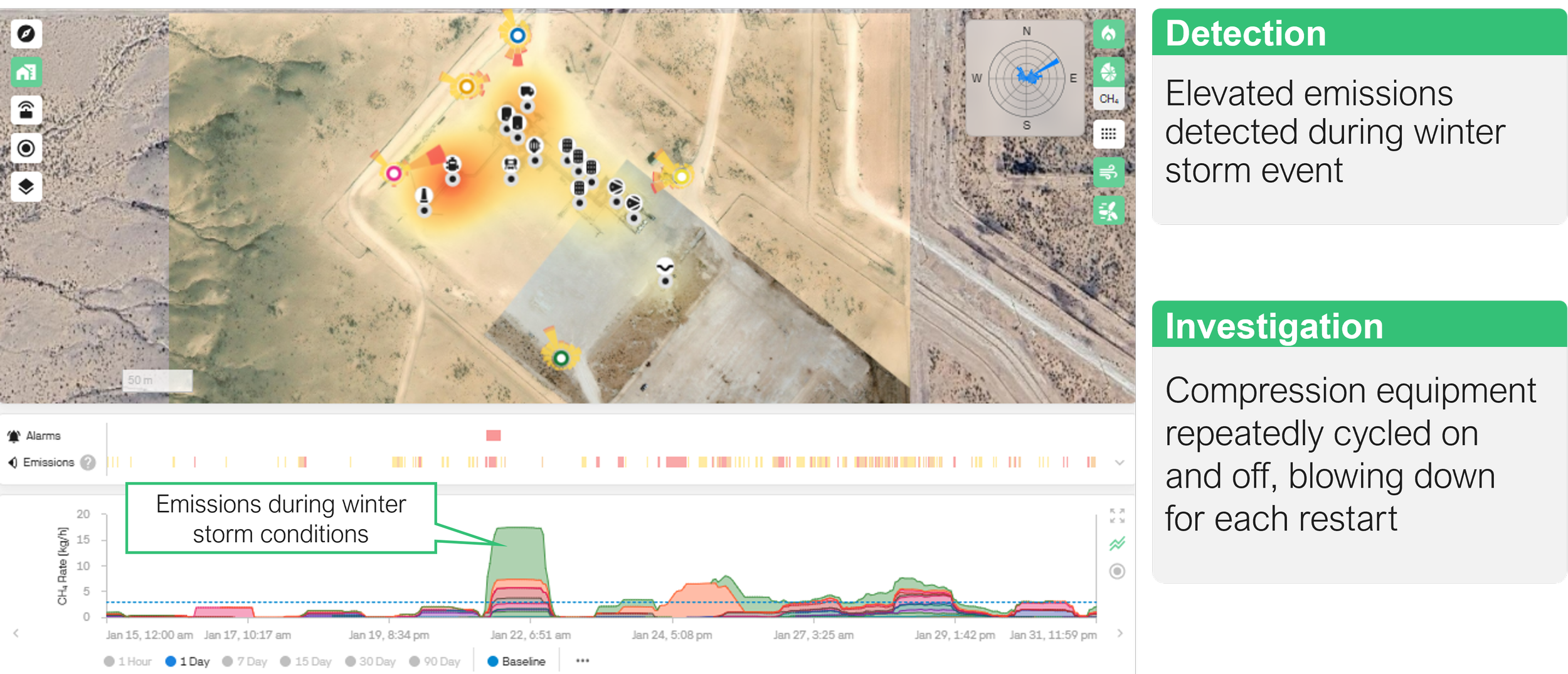
Qube Fenceline devices deployed around the perimeter of the site detected, localized and timebound emissions during compression equipment blowdowns.
Root Cause
Ice blockages and freezing conditions were affecting the compression equipment. In severe winter conditions, ice can form in fuel gas lines, instrumentation, and suction systems, which interferes with normal compressor operation and triggers safety shutdowns. The equipment was responding correctly to the conditions, but the issue was where the emissions were directed. Blowdown lines were routed to atmosphere so every trip-and-restart sequence released pressurized gas rather than recovering or combusting it.
Fix: Re-plumbing the Blowdown Routes
All compression equipment was re-plumbed to route blowdowns to the facility sales line or flare. Gas released during a blowdown is now either recovered for sale or combusted, depending on composition and line pressure at the time of the event. The compressors may still trip in future severe weather events, but the emissions resulting from each trip are now controlled.
Outcome
Emissions returned to baseline following the re-plumbing. The monitoring system provided ongoing confirmation that blowdown events were no longer producing atmospheric releases. The fix also addressed a process gap that would have persisted unquantified through every subsequent winter event without the monitoring data to make it visible in the first place.
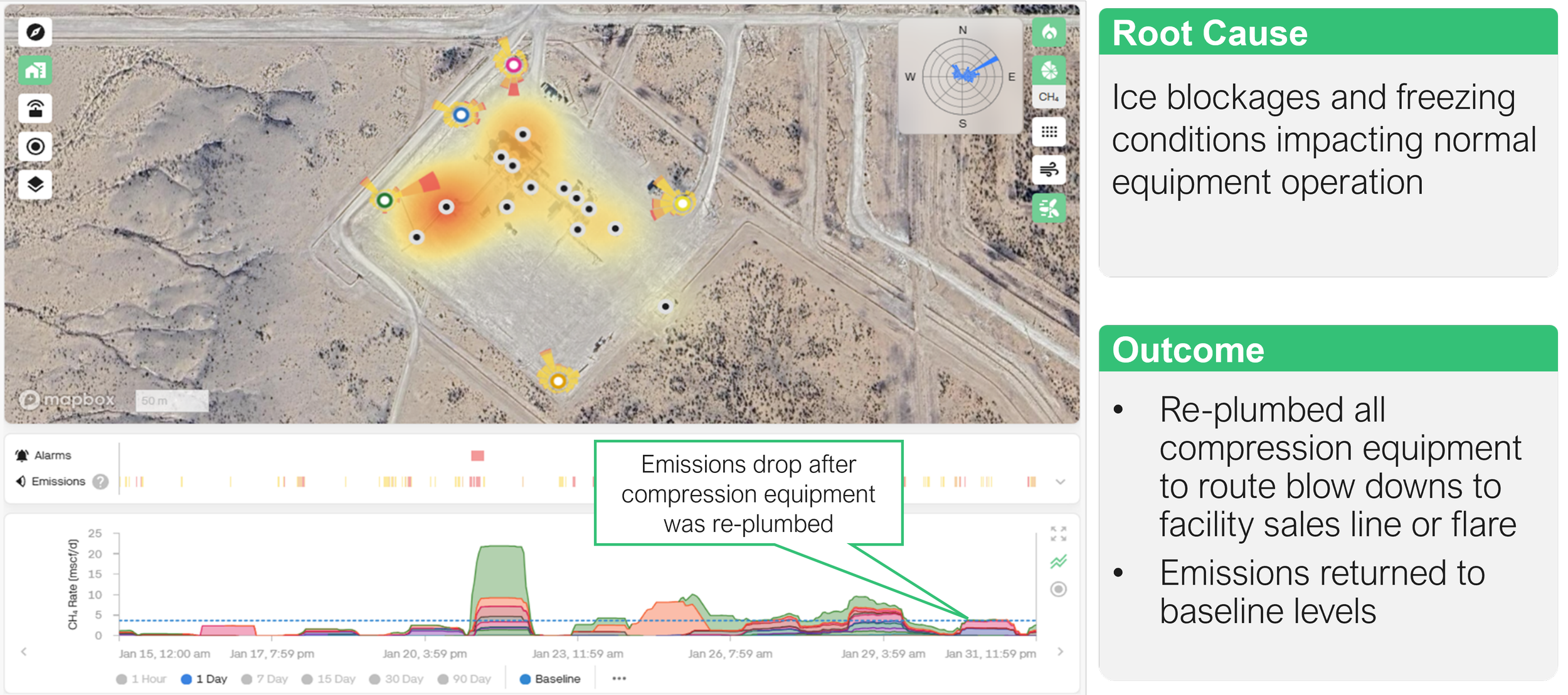
Operators can set the emission baseline on the site dashboard (blue dashed line). Following repairs, Qube Fencelines verified emissions dropped back to the baseline levels.
Key Takeaway
This case study illustrates a category of emissions event that standard operational oversight often misses: a correct equipment response to a fault condition producing uncontrolled emissions through a process gap downstream. The compressors were doing what they were designed to do. The blowdown routing was the problem. Continuous monitoring identified both the pattern and the magnitude of the emissions, which made the process gap impossible to overlook and straightforward to fix.
Interested in real-time leak detection and emissions monitoring? Get a demo from one of our experts and see how continuous monitoring can help your team find equipment problems and verify repairs faster.
Book a demo with our team today.
FAQs
-
When a compressor shuts down — whether planned or due to a trip — the pressurized gas in the compression housing needs to be safely released before the equipment can be inspected or restarted. This release is called a blowdown. The gas released is whatever was in the compression system at the time of shutdown: typically natural gas or a hydrocarbon-rich stream. If that gas is routed to atmosphere, it is released directly as an emission. If it is routed to a sales line, it is recovered and sold. If routed to a flare, it is combusted. The destination of the blowdown determines whether the event produces an emission or not.
-
Compressors rely on a number of supporting systems to operate — fuel gas supply, instrument air, cooling systems, and suction-side inlet conditions. In severe cold, ice can form in any of these systems. A blocked fuel gas line starves the engine driving the compressor. Frozen instrumentation can produce false readings that trigger safety shutdowns. Ice in the suction system affects inlet conditions and can cause the compressor to trip on performance limits. When the blockage clears — even temporarily — the equipment restarts, only to trip again when conditions deteriorate. In a sustained storm event, this cycle can repeat many times, generating a blowdown with each trip.
-
Blowdown routing is a design and commissioning decision made when equipment is installed. Routing to the sales line requires that the blowdown gas pressure is compatible with line pressure at the time of the event. Routing to flare requires piping infrastructure connecting the compression skid to the flare header. In many installations, particularly at older or smaller facilities, blowdown lines were designed to vent to atmosphere as the simplest and lowest-cost configuration. Without monitoring to quantify the emissions consequence of that choice, the practice can persist unexamined for years.
-
In practical terms, the fix involves adding or extending piping from the blowdown outlet on each compressor to either the facility's gas sales line or the flare header, depending on which is more accessible and which is appropriate for the gas composition and pressure conditions during a blowdown. The compressors themselves do not change — only the destination of the gas they release on shutdown. It is a relatively straightforward infrastructure change that has a direct and measurable effect on emissions from that point forward.
-
Monitoring provided documented confirmation that the re-plumbing had worked. After the blowdown routes were changed, the repeating spike pattern that had characterised the storm period was no longer present in the data. The facility could demonstrate, with a timestamped emissions record, that the process gap had been addressed and that blowdown events were no longer producing atmospheric releases. That verification is useful both for internal performance reporting and for any regulatory or voluntary programme documentation requirements.
For more information, explore our other resources and case studies or reach out directly.