
Proven in the Field: Qube Technologies and NGIF ETC Advance Continuous Emissions Monitoring
TL;DR
Qube is exhibiting at the Global Energy Show at NGIF's booth in Calgary, AB, on June 11, 2026.
The NGIF ETC provided real-world testing access to refine Qube's emissions monitoring algorithms at an operating gas plant.
NGIF has financially backed Qube across three rounds: equity investment, a $402K grant, and a 2026 strategic round.
Qube Lite is an intrinsically safe, near-source sensor field-tested at West Wolf Lake under the NGIF ETC.
Qube Camera adds real-time visual confirmation to the platform, giving operators timestamped documentation of emissions events.
Fenceline, Lite, and Camera each work standalone and integrate together into a single, layered continuous monitoring platform.
Introduction
There's a meaningful difference between a technology that works in theory and one that works in the field: in extreme weather, at an operating gas plant, under real industrial conditions. That gap is where many tech innovations stall. It's also the focus of the Natural Gas Innovation Fund Emissions Testing Centre (NGIF ETC).
For Qube Technologies, the NGIF ETC has been a proving ground to accelerate product development, refine our data science models, and help establish Qube as one of the most trusted and rigorously tested continuous emissions monitoring platforms.
See Qube at the Global Energy Show, June 9–11, 2026 | Calgary, AB
Qube Technologies will be exhibiting at NGIF's booth at the Global Energy Show in Calgary this June. Come see a live showcase of our continuous monitoring solutions, including Qube Fenceline, Qube Lite, and Qube Camera, and speak with our team about how the integrated platform can work at your sites.
Want a free pass? Use the Discount Code: WELCOME2026

What is the NGIF ETC?
The NGIF Emissions Testing Centre is a structured, four-stage testing and commercialization program designed to support cleantech companies developing methane-reducing technologies for Canada's natural gas industry. Operated by NGIF Capital Corporation, the ETC brings together consortium partners (including Tourmaline Oil Corp and the University of Calgary) to give selected companies access to resources that are rarely available to early-stage technology developers:
Stage 1: Eligibility evaluation
Stage 2: Controlled simulation testing at the University of Calgary
Stage 3: Live field testing at an operating industrial gas plant: Tourmaline's West Wolf Lake Gas Plant in Alberta
Stage 4: A data and outcome report to accelerate commercialization and customer creation
This plug-and-play structure is funded in part by the Government of Alberta, Alberta Innovates, Natural Resources Canada, and Prairies Economic Development Canada, a consortium that reflects just how seriously Canada's energy sector is taking methane abatement.
When Qube was selected for the program, it wasn't simply a badge of credibility. It was access to the kind of real-world operational environment that can't be simulated in a lab.
Why Real-World Testing Is Irreplaceable
Controlled release facilities and bench testing serve an important role in product development. Qube operates its own Controlled Release Test Facility (CRTF) west of Calgary, where lab-calibrated sensors are validated in configurable field scenarios simulating methane plume behavior across a range of emission rates and atmospheric conditions.
But an active gas plant is a different environment entirely. There is still the shifting wind patterns, fluctuating temperatures and pressures and multiple, simultaneous, intermittent emission sources but also the added complexity of methane concentrations rising and falling with operations from actual equipment. It is exactly this set up that drives innovation.
The West Wolf Lake Gas Plant provided Qube with field data across varying environmental and operating conditions that have been instrumental in advancing our emissions localization and quantification algorithms. The goal is not just to detect methane. It is to pinpoint where it's coming from, how much is being released, and how quickly operators need to act.
Rigorous third-party testing environments like the NGIF ETC are also increasingly critical for regulatory acceptance. Qube became the first continuous monitoring technology to receive regulatory approval in North America and has since earned formal acceptance from the U.S. Environmental Protection Agency (EPA) for periodic screening. That kind of credibility is built through transparency and third-party validation, which is exactly what the ETC is designed to provide.
A Partnership That Goes Beyond Testing: The NGIF Funding Journey
Qube's relationship with NGIF extends well beyond access to a test site. Over the past several years, NGIF has been a consistent financial partner in Qube's growth, validating the technology not just technically but commercially.
Series B Funding (February 2024)
Qube closed its Series B funding round with contributions from TC Energy, NGIF Cleantech Ventures, and Bain & Company Future Back Ventures (FBV), in addition to an initial close by Riverbend Energy Group. NGIF Cleantech Ventures is a $55 million industry-led venture capital fund that invests in early-stage clean technology, and their participation in Qube's Series B was a signal that continuous monitoring had moved from pilot-phase to core infrastructure for emissions management. This round enabled Qube to expand beyond oil and gas into landfill, mining, and agriculture sectors.
NGIF Accelerator Grant (March 2025)
NGIF Accelerator provided Qube with grant funding through its Industry Grants program, specifically to advance emissions localization and quantification through Qube's continuous methane monitoring systems. By this point, Qube had deployed over 6,000 monitoring units at more than 1,000 sites globally. The grant was designed to help Qube refine its technology and provide operators with the scalable tools needed to continuously detect, localize, and quantify their emissions.
Strategic Funding Round (February 2026)
Most recently, Qube announced the close of a new strategic funding round led by TC Energy with continued participation from NGIF Capital. This round followed a landmark 2025 for the company, which included record-breaking revenue growth, expansion into biogas/RNG and mining sectors, blinded third-party performance validation at METEC, and Qube's data becoming the first continuous monitoring dataset accepted for Level 5 OGMP2.0 reporting. The 2026 round is specifically earmarked to accelerate deployment of Qube's expanded product portfolio, including Qube Lite and Qube Camera.
The consistency of NGIF's involvement, spanning equity investment to grant funding to ongoing ETC access, reflects a uniquely integrated support model. As NGIF President and CEO John Adams noted when announcing the 2025 grant, the goal is "de-risking clean technologies through field trials and pilots" as part of an "integrated model of industry validation, customer creation, and technology commercialization." For Qube, that's exactly what it has been.
The Next Phase at the NGIF ETC: Qube Lite and Qube Camera
Qube’s recent work at the NGIF ETC has centred on two new additions to the product portfolio: Qube Lite and Qube Camera. Each was developed to solve a specific gap in how operators monitor, confirm, and act on emissions at their sites. Each operates as a fully capable standalone tool within the existing Qube platform. Together, when integrated with Qube Fenceline, they form a monitoring architecture that is more accurate, more precise, and more actionable than any single-device approach.
Qube Lite: Intrinsically Safe Source Monitoring
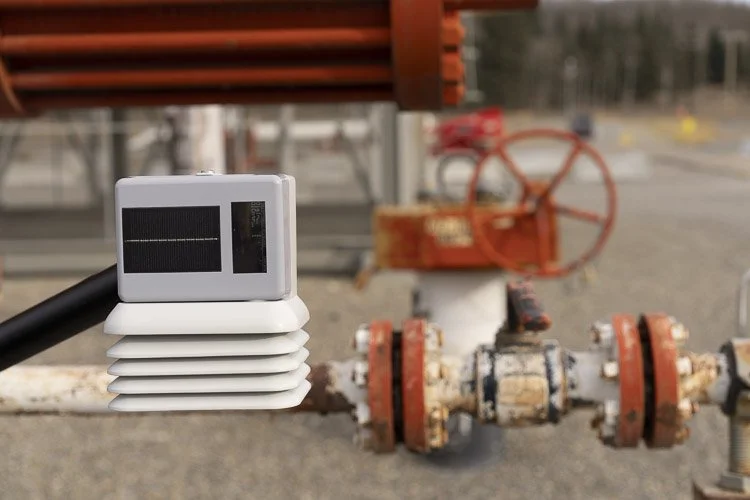
Qube Lite is an intrinsically safe, lower-cost continuous monitoring sensor purpose-built for near-source deployment. Unlike the Qube Fenceline device, which monitors the perimeter of an entire facility to detect, localize, and quantify site-level emissions, Qube Lite is designed to mount directly on or near individual pieces of equipment: tanks, separators, wellheads, compressors, and similar assets.
The deployment of Qube Lite at Tourmaline's West Wolf Lake Gas Plant under the NGIF ETC program was the product's first major real-world field test, coming after initial validation at Qube's CRTF. The results were immediately tangible. Upon activation in the field, Qube Lite devices began detecting small releases from storage tanks right away, feeding data directly to Qube's monitoring dashboard in real time.
Getting an intrinsically safe device operational in a live production facility (on a rainy day in August, no less) and having it stream clean, actionable data from the moment it came online is a validation in its own right. Intrinsic safety is a non-negotiable requirement for electrical equipment operating in classified hazardous areas where flammable gases may be present. For operators, it means Qube Lite can be installed inside the facility boundary, in proximity to the very equipment most likely to be a source of emissions, without compromising site safety.
Used as a standalone tool, Qube Lite delivers continuous equipment-level monitoring within the same Qube platform operators already use. Alarms, emission trends, and source attribution data from Qube Lite are surfaced directly in the Qube dashboard, with no separate system and no additional integration overhead. For sites where the priority is granular visibility at specific high-risk assets, Qube Lite can be deployed independently and deliver value immediately.
Qube Camera: Visual Confirmation at the Source
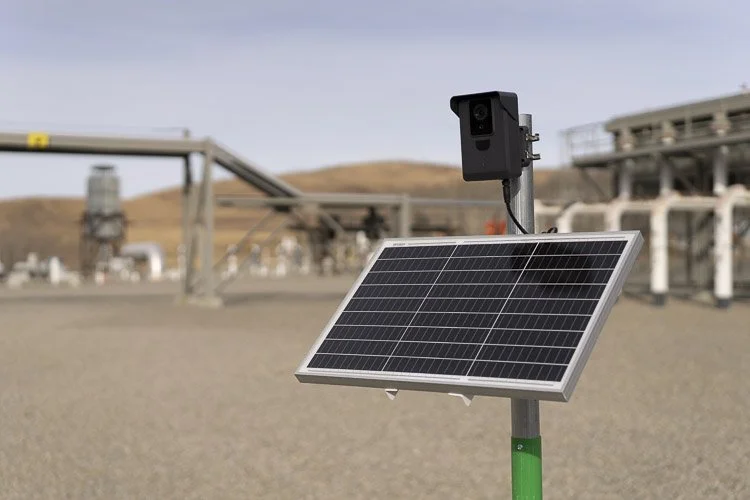
Qube Camera is an advanced visual monitoring tool designed to provide real-time visual confirmation of emissions events and enhanced leak localization. Where Qube Lite and Qube Fenceline quantify what's happening, Qube Camera provides the operational context. It gives operators direct, interpretable evidence what is happening when an emission event is occurring, where it is located, and when it has been resolved.
As emissions monitoring establishes itself as a leading indicator of equipment status and operational efficiency, operators need not just detection and quantification data, but documentation. A verifiable visual record of activities, vehicles, equipment, and people during an emission event and its resolution closes the loop on reporting.
Used as a standalone tool, Qube Camera integrates with the same Qube platform, delivering visual data feeds and event documentation alongside other site monitoring data. For operators who need visual verification capability at specific assets or high-priority locations, Qube Camera can be deployed independently and feeds directly into the platform's event tracking and reporting workflows, with no separate viewing interface required.
The Integrated Platform: Fenceline + Lite + Camera
Each product delivers value on its own. But the compounding effect of deploying all three together (within a single, unified Qube platform) is where the most meaningful operational gains are realized.
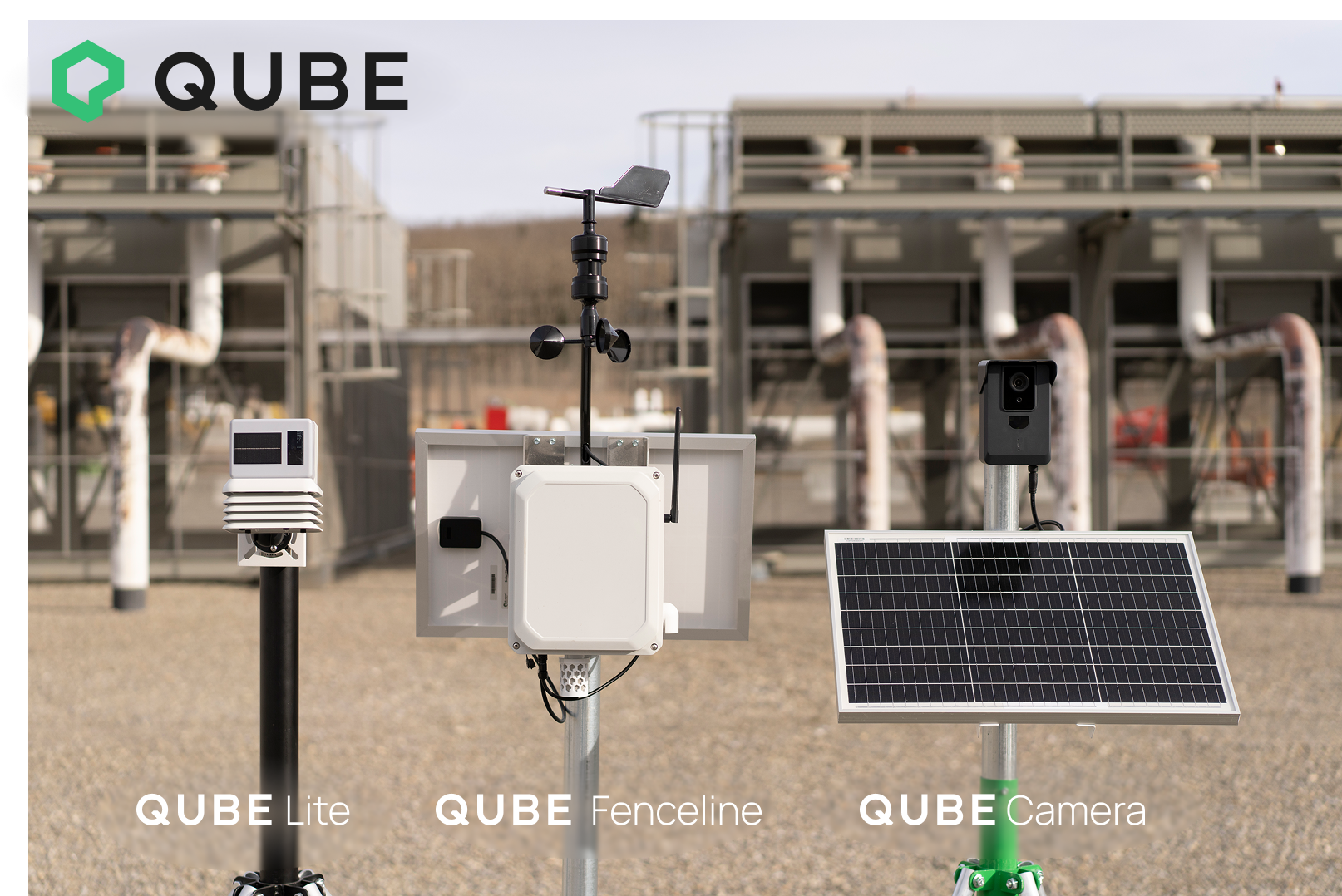
Qube Fenceline
Qube Fenceline establishes site-wide situational awareness. Deployed at the perimeter, it continuously monitors ambient methane concentrations, processes meteorological data, and runs physics-driven dispersion modeling to detect, localize, and quantify emissions across the entire facility footprint. It answers the questions: is this site emitting, where is the general source area, and how much?
Qube Lite
Qube Lite adds equipment-level resolution. When Fenceline identifies an emission in the vicinity of a tank battery, a separator skid, or a cluster of wellheads, Qube Lite narrows the answer from an area to a specific unit. At a tank farm where multiple tanks are spaced closely together, that distinction is the difference between sending a maintenance crew to inspect six tanks or sending them directly to the one that's leaking.
Qube Camera
Qube Camera closes the loop with visual confirmation. Once Fenceline has flagged an emission and Lite has localized it, Camera provides the visual evidence: a timestamped, platform-integrated record showing the emission, its location, and its resolution. This isn't just useful for internal operations. It is increasingly essential for regulatory submissions, third-party audits, and ESG reporting that require documented proof of both the emission event and the corrective action taken.
Together, this three-layer system addresses the most persistent operational challenge in emissions management: the gap between detection and verified repair. Continuous quantification from Qube Fenceline ensures nothing is missed at the site level. Equipment-level precision from Qube Lite eliminates wasted investigation time. Visual confirmation from Qube Camera creates an unbroken chain of evidence from event onset to resolution.
The NGIF ETC testing environment at West Wolf Lake has been instrumental in developing and validating this integrated approach, providing the real-world operating conditions needed to optimize how the three products communicate, how alarms cascade through the platform, and how the combined data set supports faster, more confident decision-making by operators and their teams.
As CEO Alex MacGregor put it when announcing the 2026 funding round: "With the continued support of TC Energy and NGIF, we are ready to scale Qube Lite and Qube Camera to help our partners move from simple detection to precise, actionable emission reductions."
What This Means for Operators
For operations managers, plant managers, and emissions program leads working in oil and gas, the trajectory of Qube's development at the NGIF ETC translates directly into better operational outcomes:
Faster leak detection.
Equipment-level sensors mean alarms are triggered at the source, not inferred from fenceline data. Response times are shortened.
More precise localization.
At complex sites with dozens of potential emission sources, knowing which tank, which separator, or which wellhead is emitting cuts the time and cost of investigation significantly.
Stronger compliance documentation.
The combination of continuous quantitative data (from Fenceline and Lite) and visual confirmation (from Camera) creates an audit-ready record that satisfies the documentation requirements of increasingly stringent regulatory frameworks, including EPA periodic screening and OGMP Level 5 reporting.
Lower total cost of emissions management.
Qube Lite's lower cost per unit means operators can achieve near-source monitoring coverage at scale without the capital expense of deploying full Fenceline installations at every asset location.
The rigor of the NGIF ETC testing process and the field data it has produced means that operators deploying this platform aren't running an experiment. They're implementing a technology that has been tested under real operating conditions, validated by third parties, and supported by a funding ecosystem that has consistently backed Qube's ability to deliver.
Looking Ahead
Qube's partnership with the NGIF ETC is ongoing, and so is the product development it enables. The work at West Wolf Lake continues to generate data that feeds back into algorithm refinement, device placement optimization, and platform integration. What began as field validation for the original Qube Fenceline device has evolved into a full-scale product development and integration program for the next generation of Qube's monitoring technology.
For Canada's natural gas sector and the growing number of industries where methane monitoring is becoming a regulatory and ESG imperative, that kind of rigorous, collaborative, industry-supported innovation is exactly what the transition to lower-emission operations requires.
Want to learn more about Qube Lite, Qube Fenceline, or Qube Camera?
Explore our Products page, browse our case studies and white papers, or schedule a demo to see how Qube's integrated platform can work at your site.
Attending the Global Energy Show in Calgary? Find us at the NGIF booth, on June 11, 2026. We'll be showcasing our full continuous monitoring platform and our team will be on hand to walk through how Qube Fenceline, Qube Lite, and Qube Camera can work together at your operations.
Acknowledgements
The NGIF Emissions Testing Centre Program involves collaboration between industry, academia, and government. It involves public support to ensure cleantech companies have a dedicated space to develop, test, and field-validate technologies to measure, monitor, and reduce methane emissions, and to fast-track methane technologies to market through knowledge dissemination and fostering commercialization. The program is unique in that it provides cleantech companies with free access to testing and commercialization support for rapid scale-up of technologies from concept to commercial-ready deployment. The NGIF ETC Program's lab at the University of Calgary provides capabilities to test and de-risk technologies in a controlled environment, complemented by live field trials at the West Wolf Lake Gas Plant (jointly owned by Tourmaline Oil Corp. and Rubellite Energy), along with other Tourmaline assets. NGIF Accelerator supports technology developers in scaling up by disseminating knowledge and providing commercialization support.
The NGIF Emissions Testing Centre (ETC) program is currently supported by the Government of Alberta (Environment and Protected Areas), whose funding enables the testing and commercialization of methane reduction technologies. This public support ensures the technology providers have the resources and infrastructure to advance innovative solutions that measure, monitor, and reduce methane emissions, while accelerating their path to market adoption.
This project was made possible through the NGIF Emissions Testing Centre (ETC) Program, with generous support and funding from the Government of Alberta. We gratefully acknowledge the contributions of the Ministry of Environment and Protected Areas (AEPA), whose dedication to innovation and technological advancement has played a pivotal role in the success of this initiative.