
The Business Benefits of Continuous Monitoring
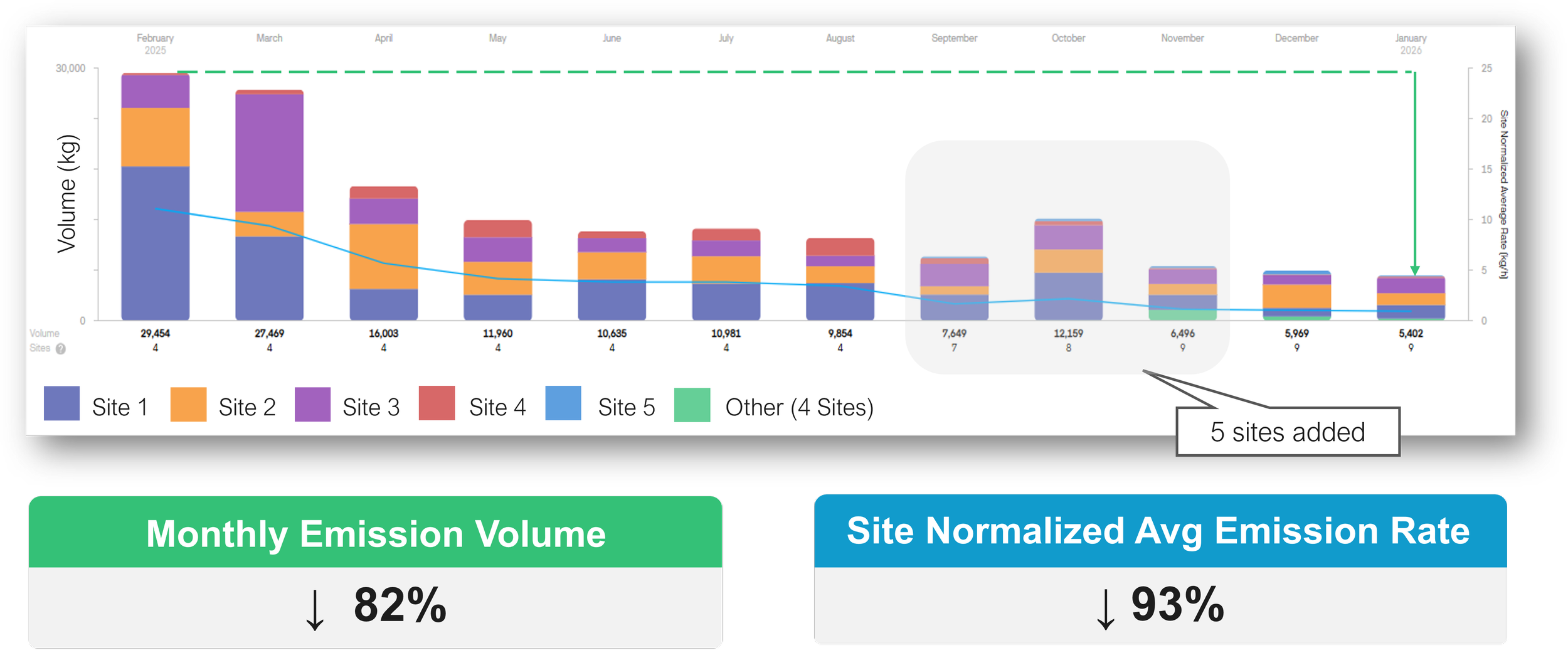
Continuous emissions monitoring delivers more than detection. Across a multi-site upstream oil and gas deployment, the data shows a 93% reduction in monthly emission volume, a 75% reduction in inspection costs, and documented equipment repair savings.
Introduction
Continuous emissions monitoring is typically evaluated on its ability to detect and document emissions events. Those are the right criteria. They are not, however, the full picture of what a well-deployed monitoring programme delivers. Across a multi-site upstream oil and gas deployment, the business impact data shows reductions in emissions, inspection costs, and equipment repair expenditure. Here is what those numbers look like and how they are produced.
Scalable Emissions Reduction
Across a multi-site deployment, monthly emission volume decreased by 93%. Site-normalized average emission rate decreased by 82%. For both of these reductions, monitoring makes emissions events visible in real time, which shortens the interval between event onset and repair. Shorter repair windows mean less total volume emitted per event. As monitoring is extended across additional sites, that effect compounds.
The two metrics measure different things and are both worth reporting. The 93% reduction in total monthly volume captures the absolute scale of emissions eliminated. The 82% reduction in site-normalised average rate accounts for variation in site size and production activity, making it a more consistent benchmark for comparing performance across different facility types.
Cost Savings: Less Inspections, Less Costs, Faster Repairs
Continuous monitoring data supports a reduction in on-site inspection frequency. With real-time emissions coverage across the monitoring period, operators can move from quarterly to annual on-site inspections while improving their ability to detect and respond to events. The monitoring system provides the between-inspection visibility that better captures intermittent, activity-related, and concurrent emission events.
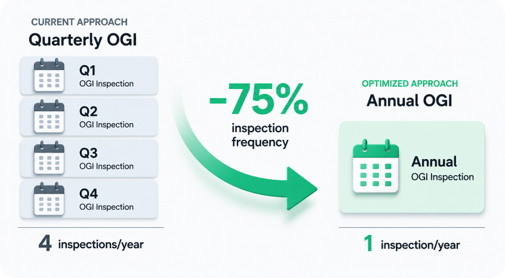
That reduction in inspection frequency also scales efficiently. Extending a monitoring programme from four sites to nine does not require proportional growth in the inspection team. Early detection also reduces equipment repair costs. Catching an issue before it escalates or causes downstream damage avoids the more expensive repairs that follow from late detection. In one documented event, identifying a malfunctioning back pressure regulator on a dehydration unit skid before pressure loss progressed avoided dry pumping conditions, glycol pump damage, and potential full glycol storage system replacement. The indirect cost saving from that single event at one site was $9,000.
Read the full case study here: How Qube’s Continuous Monitoring Caught a Regulator Malfunction and Saved $9,000
Operational Performance
Repair verification is built into the monitoring record. After a repair is completed, the data confirms whether emissions returned to baseline without a separate follow-up inspection. Equipment and process issues that produce no obvious visible symptoms are surfaced through pattern detection rather than through manual observation. Super-emitter events, which carry both regulatory and reputational exposure, are less likely - and less likely to be left for third parties to observe and report - when continuous monitoring is in place across the asset base.
Watch the Webinar
These figures were presented alongside five real-world case studies in our recent webinar, Continuous Monitoring in Practice. The session covers the detection, investigation, and resolution of emissions events across upstream oil and gas operations, from equipment failures to process design gaps exposed by severe weather conditions.
Watch the full session on demand: Continuous Monitoring in Practice: Case Studies in Cost, Performance, & Emissions Reduction