
How Continuous Monitoring and SCADA Data Connected Truck Loading Events to VRU Shutdowns
Elevated emissions near a tank farm were detected during truck loading activities. Here's how cross-referencing continuous monitoring data with SCADA data traced the emissions to VRU shutdowns caused by oxygen intrusion, and how rerouting the vapor line resolved it.
Introduction
Not every emissions event is caused by equipment failure. Sometimes a routine operational activity produces an unintended consequence elsewhere in the process. This case study examines how continuous emissions monitoring identified a repeating pattern of emission spikes tied to truck loading events, and how cross-referencing monitoring data with SCADA records traced those spikes to a specific mechanical chain: oxygen-containing truck vapors entering the facility's vapor recovery system, triggering VRU shutdowns, and causing the venting that followed.
Emissions Detected: A Pattern of Repeating Spikes
Qube's monitoring system detected elevated emissions near the truck loading area and tank farm. The distinguishing feature of this detection was the pattern: the spikes were not random or continuous. They tracked consistently with truck loading activity. Continuous monitoring data provided the time-resolved record needed to make that correlation visible — something periodic inspections would have been unlikely to capture given the event-driven nature of the emissions.
The Investigation: Connecting the Data Streams
The team cross-referenced continuous monitoring data with SCADA trends. The correlation was consistent: elevated emissions appeared during truck loading events and subsided when loading was not occurring. That pattern narrowed the investigation and the question shifted from where the emissions were coming from to why truck loading was producing them.
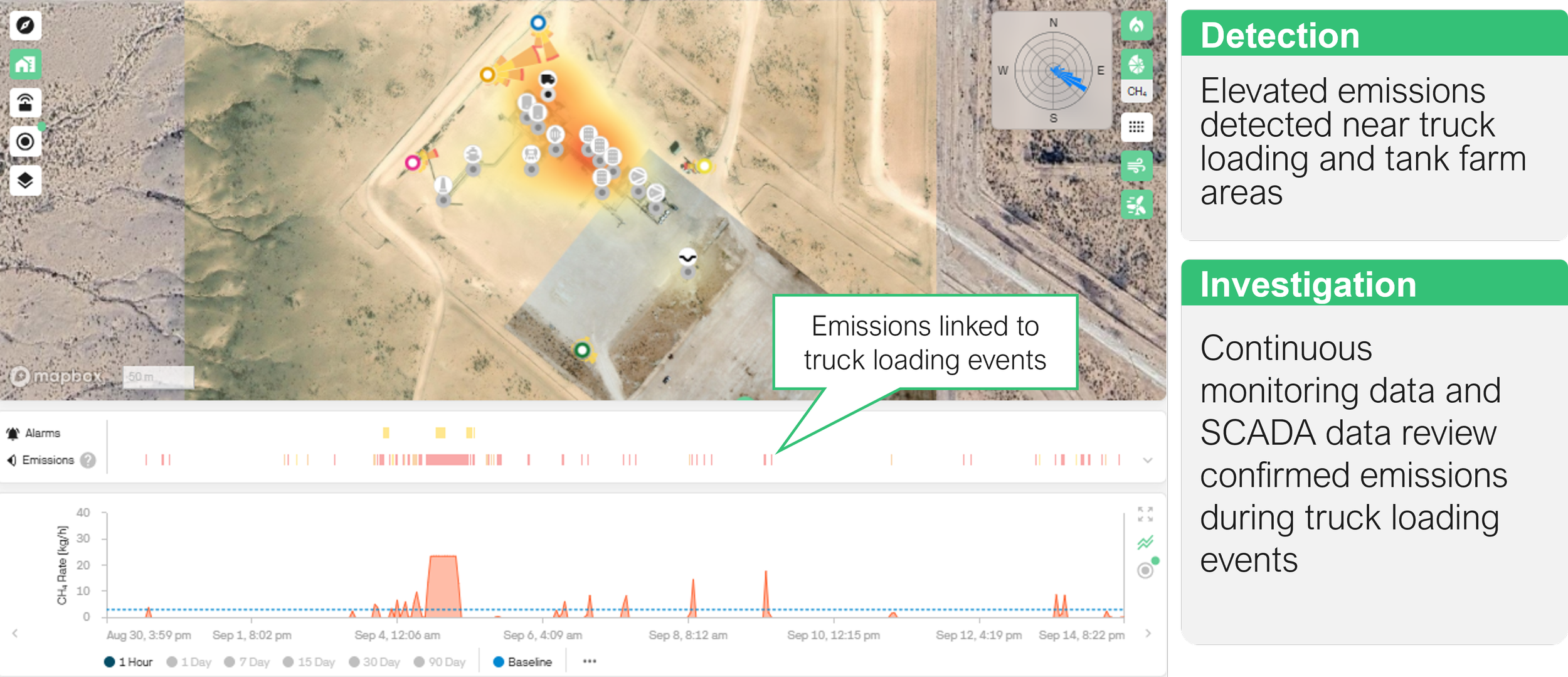
Qube’s platform visualizes the site emissions on the map and emissions trend chart showing repeating spike pattern correlated with truck loading events. The regularity and timing of the spikes makes it immediately apparent that the emissions are tied to a predictable operational event rather than a random equipment failure.
Root Cause: Oxygen Intrusion and the VRU Shutdown Process
When a tanker truck arrives to load, its vapor space contains ambient air. As product fills the truck, that air is displaced and pushed back into the facility's vapor line. VRUs are not designed to handle oxygen-containing streams: oxygen mixed with hydrocarbon vapors creates a flammable mixture, and the unit's safety controls will shut it down automatically when oxygen is detected at the inlet.
Each VRU shutdown meant the facility's vapor recovery was offline for the duration. Vapors from the tank farm that would have been captured and routed to the sales line were instead vented to atmosphere. The truck loading event itself was not the emission source. It was the trigger for a downstream equipment response that released the emissions.
Fix: Rerouting the Vapor Line
The truck loading vapor line was rerouted downstream of the main Enardo valve, directing those vapors to the flare for combustion rather than into the VRU system. With truck vapors no longer entering the VRU inlet, oxygen intrusion was eliminated. The VRU could operate continuously through loading events without safety-triggered shutdowns.
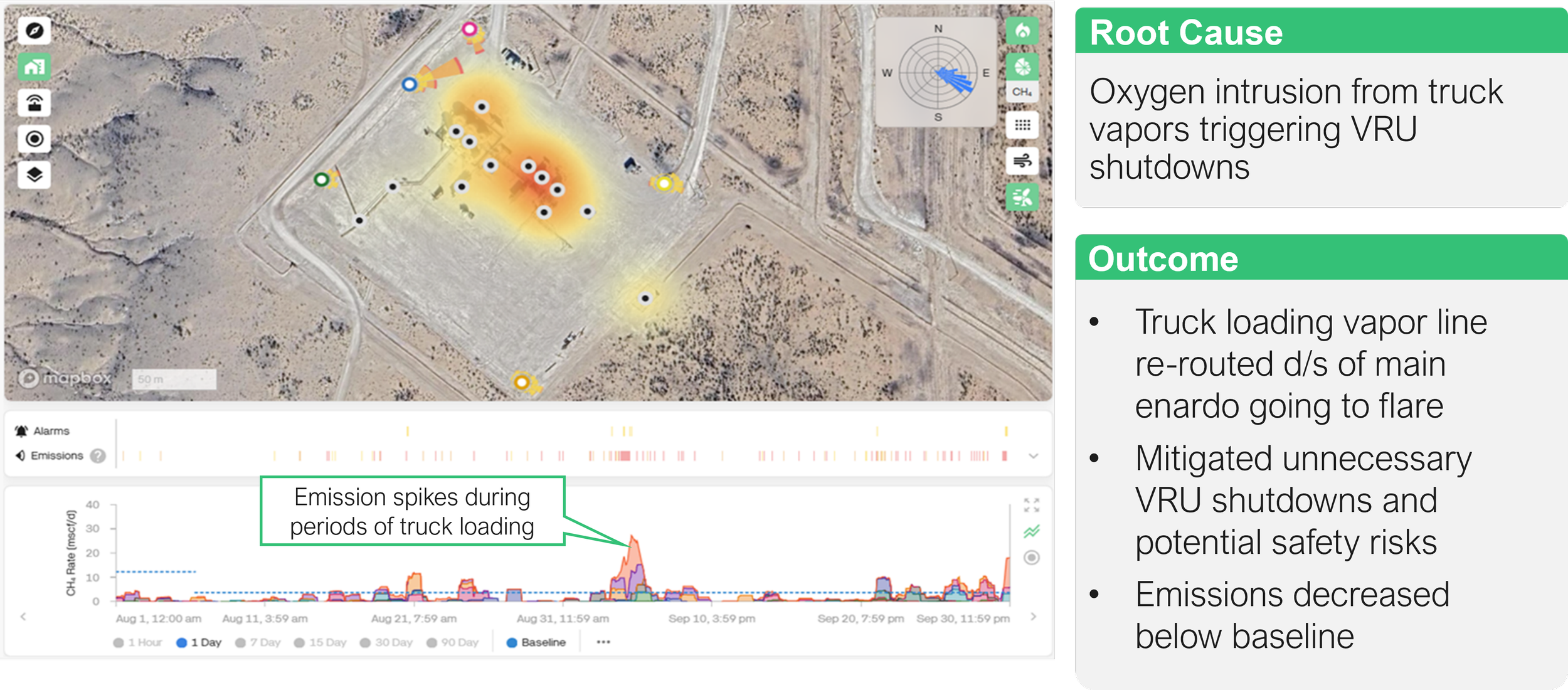
Qube's continuous monitoring detected the emission spikes, localized the source to truck loading activity, and confirmed that emissions decreased below baseline after the vapor line was rerouted.
Outcome
The operator combined Qube’s continuous monitoring with SCADA data to mitigate VRU shutdowns. Emissions decreased below baseline as the VRU remained online and recovered vapors that had previously been venting during each shutdown. The rerouting also addressed a latent safety risk: repeated oxygen intrusion events in a hydrocarbon vapor system carry ignition potential.
Key Takeaway
The emission source in this case study was a design gap in how one operational activity interacted with another part of the system. Continuous monitoring identified the pattern, cross-referencing with SCADA provided the diagnosis, and the fix addressed both the emissions outcome and the safety risk behind it. Without the time-resolved data to connect truck loading activity to VRU behavior, this interaction could have continued undetected indefinitely.
Interested in how Qube Technologies can help you reduce risk and operational costs across your asset base?
FAQs
-
A vapor recovery unit (VRU) captures hydrocarbon vapors displaced from storage tanks and other vessels, compresses them, and routes them to a sales line or other recovery point rather than venting them to atmosphere. VRUs are designed to handle hydrocarbon streams and not air. When oxygen enters the VRU inlet, it creates a potentially flammable mixture with the hydrocarbon vapors already in the system. VRU safety controls are designed to detect this condition and shut the unit down automatically to prevent ignition. The shutdown protects the equipment and personnel, but it also takes vapor recovery offline, meaning any vapors generated during the shutdown period are vented rather than recovered.
-
When a tanker truck arrives to load at a facility, its vapor compartment contains ambient air from the previous trip or from sitting empty. As product is pumped into the truck, the air in the vapor space is displaced and pushed out through the truck's vapor return line, which connects back to the facility's vapor system. That return stream carries oxygen. If the vapor return line is routed to the VRU inlet, the oxygen travels with it. In facilities where the vapor return connection is upstream of the VRU, this happens with each loading event.
-
A VRU in normal operation continuously recovers vapours from the tank farm and routes them to the sales line. When the VRU shuts down, that recovery pathway is interrupted. Vapors that continue to be generated by the tanks — from temperature changes, product movement, or ambient pressure variation — have nowhere to go except through the tank's pressure relief pathway, typically a thief hatch, Enardo valve, or vent to atmosphere. The duration and frequency of VRU shutdowns directly affects how much vapour is vented rather than recovered. In a facility with regular truck loading activity, repeated shutdowns can accumulate into a significant emissions profile over time.
-
The truck loading vapor line was rerouted to a connection point downstream of the main Enardo valve, where it ties into the vapor line going to the flare. This means truck vapors — including any oxygen content — are directed to the flare for combustion rather than to the VRU inlet. The flare is designed to handle variable-composition streams including those with oxygen. The VRU inlet now only receives vapours from the tank farm system, which are hydrocarbon streams without ambient oxygen. This separation eliminates the oxygen intrusion mechanism entirely.
-
The key was the time resolution of the monitoring data. Continuous monitoring tracks emissions in intervals short enough to reveal event-driven patterns — spikes that appear, persist for a period, and then subside. When those spikes were plotted against SCADA records showing truck loading activity timestamps, the correlation was direct and repeatable. A quarterly or annual inspection would have captured a site emissions rate but not the pattern that linked the rate to a specific operational trigger. Without the temporal granularity of continuous monitoring, the connection between loading events and VRU behavior would have required considerably more investigative work to establish — if it was established at all.