
Achieving OGMP 2.0 Level 5 with Continuous Monitoring
Summary
OGMP 2.0 provides a structured pathway for oil and gas operators to improve methane emissions reporting, progressing from simple estimates (Levels 1–2) to detailed, measurement-driven inventories (Levels 4–5). Achieving Level 5 “Gold Standard” requires combining source-level inventories with independent, site-level measurements and reconciling the two datasets.
Qube Technologies enables this progression by delivering continuous (24/7) site-level measurements, structured mapping to OGMP source categories, and integrated reporting tools. Through statistical methods such as spatial extrapolation, probability of detection modeling, and uncertainty quantification, operators can scale measurements across assets and complete reconciliation with confidence—meeting Level 5 requirements efficiently and credibly.
Watch the video below on achieving OGMP 2.0 Level 5 with continuous monitoring.
Why are Oil and Gas Producers joining OGMP 2.0?
Confidence
Provide confidence to regulators, investors, and the public that O&G operators manage emissions responsibly and towards disclosed targets. For investors, poor methane control may be viewed as operational inefficiency
Market Access
Open new markets for saleable O&G products. This is especially relevant for EU markets and hyperscalers, where “low methane intensity” products are preferred or required.
Cost Savings
OGMP 2.0 reporting provides a systematic framework for evaluating methane emissions, which helps prioritize the most material sources. Methane that’s kept in the pipe can be sold for profit.
How OGMP 2.0 Reporting Progression Works
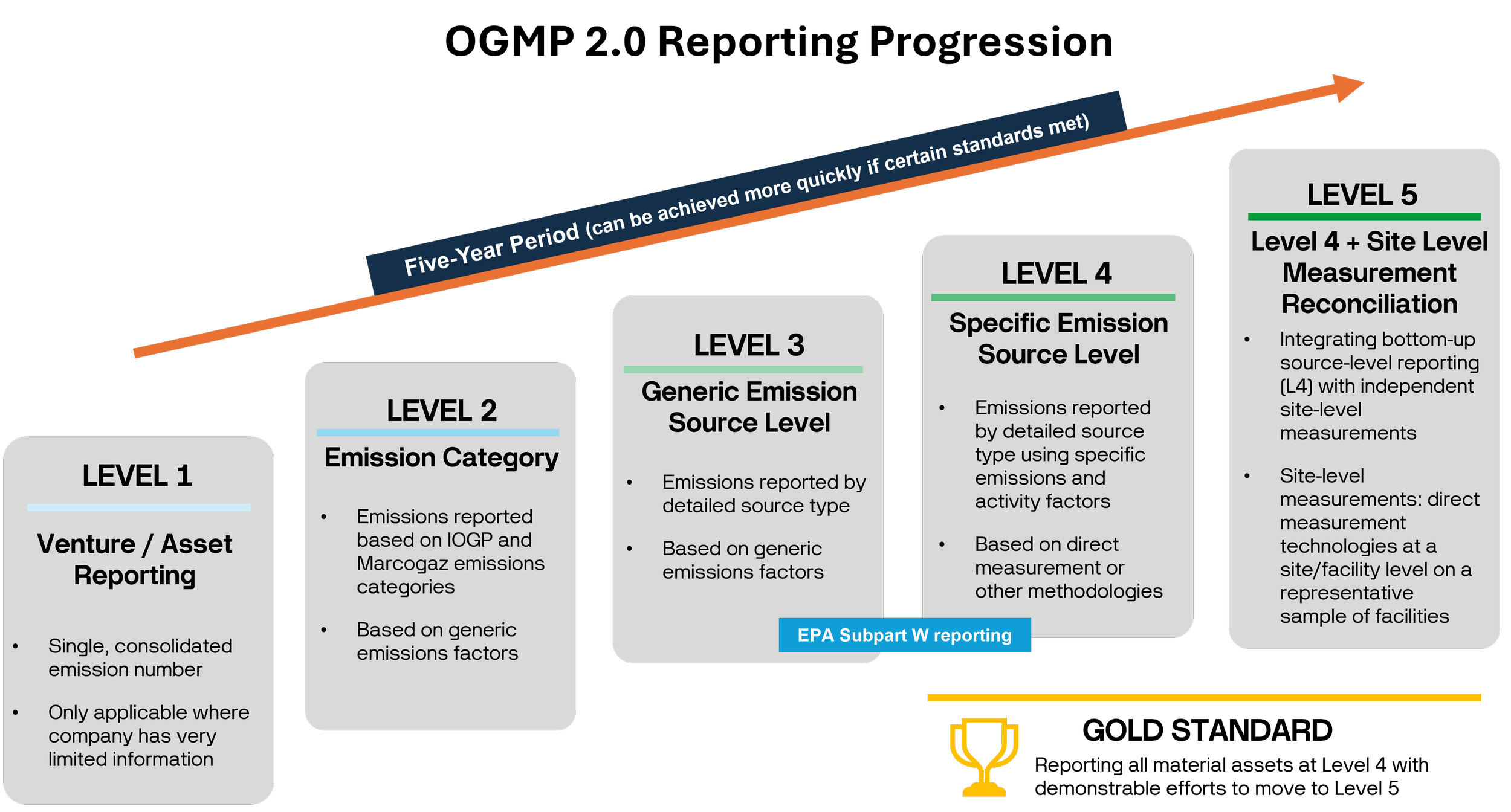
When a company becomes an OGMP 2.0 reporting organization, it commits to a multi-year progression toward increasingly granular measurement and reporting, particularly for material assets.
Level 1 and Level 2 reporting are relatively simple, relying on a single estimate derived from publicly available data and generic emission factors. These “bottom-up” inventory estimates are most appropriate for operators at the beginning of their OGMP 2.0 journey or for assets that are not considered material.
Level 3 represents a level of reporting with which most operators are already familiar. It uses generic, source-level emission factors similar to those applied in EPA Subpart W reporting.
Levels 4 and 5 are the targets that most companies aim to achieve. Reaching Level 4, with a clear pathway toward Level 5, is generally considered the “gold standard.” While Level 4 still relies on a bottom-up inventory approach, it requires investment in source-specific emission factors—typically developed through statistical sampling of field sources using methods such as calibrated bagging or high-flow sampling—as well as improved activity data (e.g., tracking events like blowdowns).
Level 5 builds on this foundation by incorporating site-level measurements and reconciling them with Level 4 inventory estimates.
What Does OGMP 2.0 Level 5 Require?
Source-Level Reporting
All material must be reported at Level 4. Level 4 reporting is based on “bottom-up” estimates that use source-level measurements and sampling to develop specific emission and activity factors.
Site-Level Measurement
OGMP 2.0 Level 5 takes all of the operator specific emission factors & activity factors required for a Level 4 report and layers on top independent site-level measurements using advanced methane measurement technologies. Continuous monitoring measurements can contribute to site-level measurements that support this reporting level.
Reconciliation
A critical component of Level 5 reporting is reconciliation. At this stage, source-level and site-level measurements are systematically compared through a structured, year-over-year process. This reconciliation enables operators to identify discrepancies between source-level and site-level measurements and refine measurement frequency, methodologies, and technologies to improve overall data quality and accuracy.
How Continuous Monitoring Contributes to OGMP 2.0 Level 5
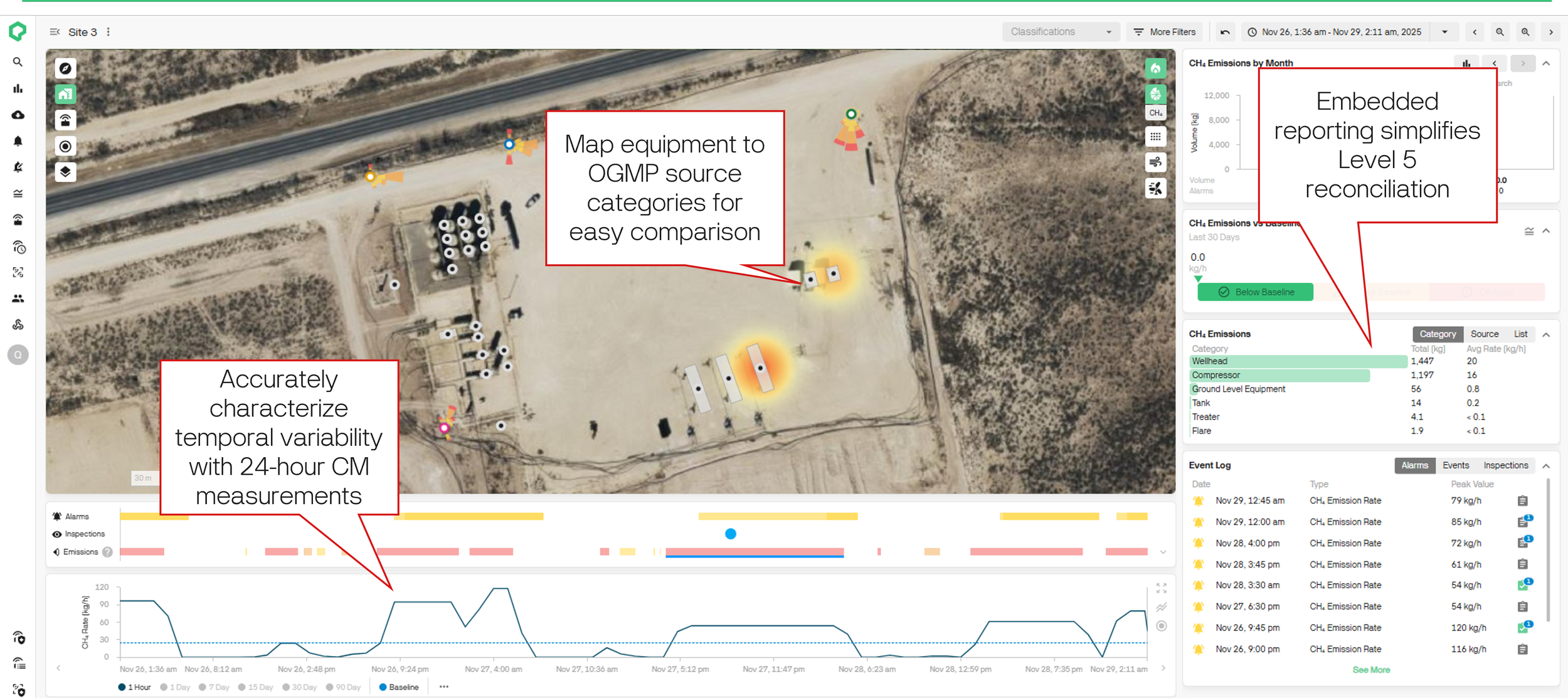
Below is an example of a site within the Qube Platform. Three primary data streams support site-level measurement and reporting.
The first is the site-level measurement data itself. Measurements are collected continuously (24/7), capturing the temporal variability of emissions and enabling the identification and time-bounding of operational events such as compressor blowdowns.
The second is the structured mapping of equipment to OGMP 2.0 source categories within the Qube system. While site-level measurements are the foundation of Level 5 reporting, this standardized classification enables efficient comparison between site-level measurements and source-level inventory data.
The third is embedded reporting functionality. This allows users to efficiently generate and export annual methane (CH₄) emissions summaries, supporting OGMP 2.0 reporting requirements.
Case Study: Achieving OGMP 2.0 Level 5 Gold Standard with Qube
Overview
In this case, a major US operator used Qube’s continuous emissions monitoring to achieve OGMP 2.0 Level 5 Gold Standard. The project spanned 35% of sites in a single basin, covering diverse facilities and production profiles. It’s important to note the approach used by this operator should not be viewed as prescriptive because there is a lot of flexibility for operators to define their own program and ultimately report in a way that makes aligns with their operations.
Approach
Site Selection
Operator categorized facilities into five generations by design age and production capacity. A representative subset, focused on newer, high-producing sites, was monitored for maximum emissions capture.
Category mapping
Qube’s detailed equipment tagging was matched to OGMP categories (e.g., stationary combustion, fugitive emissions, flaring) to ensure precise alignment with reporting requirements.
Spatial extrapolation
Emissions data from monitored sites was extrapolated to non-monitored sites within each category.
PoD Simulation
Qube’s 90% Probability of Detection (PoD) at ~1.5 kg/h allowed statistical modeling of emissions below this threshold, which were added to the inventory.
Uncertainty Calculation
Min/max emission outputs were used to calculate error bars for reported emissions.
Reconciliation
Qube’s error bars overlapped with the operator’s bottom-up inventory. Reconciliation was complete.
Results
Operator achieved OGMP 2.0 Level 5 with credible site-level measurements.
Scaled partial site coverage using statistical extrapolation.
Validated accuracy, eliminating post-report adjustments.
Conclusion
Qube Technologies provides the emissions measurement infrastructure, data structuring, and analytics required to achieve OGMP 2.0 Level 5 Gold Standard reporting. By integrating continuous site-level monitoring with robust reconciliation workflows, operators can produce defensible, high-quality emissions inventories that meet regulatory and market expectations.
Want to learn how Qube Technologies can help you achieve OGMP 2.0 Level 5 Gold Standard?